
Introduction
A seawall has a hard job. It holds back soil, resists wave action and shifting water levels, and sits in moisture year-round, all without becoming a maintenance burden. Wood rots, steel rusts, and reinforced concrete cracks as chlorides reach the rebar.
Composite sheet piling offers another route. These interlocking panels form a continuous wall for seawalls, bulkheads, retaining walls, and erosion-control projects. But "composite" covers two different materials: fiberglass-reinforced polymer (FRP) and rigid PVC (vinyl). They are not interchangeable, and this guide shows how to tell them apart and choose between them.
Key Takeaways
- Composite piling resists rot, rust, and borers, but performance depends on the specific product and design.
- FRP and PVC differ in stiffness, profile, and wall-height capability.
- Soil, water levels, waves, surcharge, scour, and drainage drive material choice.
- An engineer should verify embedment, anchoring, interlocks, and permits.
Understanding Composite Sheet Piling for Seawalls
What composite sheet piling means
Sheet piling is a set of interlocking vertical panels installed into the ground to form a continuous wall. The Army Corps of Engineers distinguishes the two roles clearly: bulkheads mainly retain land, while seawalls mainly reduce wave erosion and landward flooding.
"Composite" is a loose term. Federal guidance describes FRP as pultruded fiberglass-reinforced polyester or vinyl ester. PVC piling is rigid, UV-inhibited vinyl. A vinyl panel is not FRP, so specify each by its own name.
How the wall system works
The panel is one component. Stability comes from the whole system:
- Embedment: penetration below the bed resists soil forces
- Tiebacks and anchors: rods tied to upland anchorage add restraint
- Walers: connect individual tie rods to the wall
- Caps and corners: finish the wall and tie panels together
- Backfill and drainage: free-draining fill and weep holes relieve water pressure behind the wall
Continuous interlocks do not replace structural design, water management, or toe protection. Wave reflection and toe scour reduce embedded support, which is a common failure path.
Common applications and suitability
Typical uses include lakefront and riverfront seawalls, marina bulkheads, docks, canals, ponds, retention basins, and park shorelines. Federal specifications cover permanent PVC and FRP bulkheads and retaining walls.
Suitability turns on several site factors:
- Wall height and soil strength
- Water elevation, wave action, and boat impact
- Surcharge loads and site access
- Required design life
Freshwater versus saltwater is only one input among these.
Benefits of Composite Sheet Piling for Seawalls
Resistance to corrosion, rot, and biological damage
The usual failure mechanisms differ by material:
- Steel: Saltwater corrodes faster than freshwater, and the splash zone is worse than continuous submersion
- Wood: Fungal rot and shipworms that tunnel behind tiny entry holes
- Reinforced concrete: Chlorides, moisture, and oxygen start rebar corrosion, then cracking and spalling
Polymer piling avoids those mechanisms, but it has its own failure modes: UV exposure, creep, and installation damage.
- FRP: Creative Composites Group (CCG) specifies UV absorbers in the resin plus a 10-mil polyester veil, with resin chosen by chemical exposure.
- PVC: a 2003 Corps of Engineers study found little flexural loss from accelerated aging, but UV discoloration and lower notched-impact strength.

Lightweight handling and lower-disruption installation
Light panels simplify transport and staging, and suit tight waterfront sites. Atlantis Seawall's 12-inch recycled PVC panels weigh 5.5 lb/ft, and the company states that 2–3 panels can be driven at once depending on soil. Treat time and cost savings as project-specific, not guaranteed.
Low-maintenance lifecycle performance
Polymer walls skip the repainting that steel needs, the rot repairs wood needs, and the patching concrete needs. Connections, anchors, caps, drainage, and surrounding soils still need inspection. No universal lifecycle cost ranking exists, so ask for documented project data.
Design flexibility and appearance
Custom lengths, corners, caps, and colors help with curved shorelines and varied wall heights. Atlantis offers Slate Gray and Natural Gray, which make scum lines less visible, plus a universal corner and a 45° corner.
Sustainability claims need paperwork. CMI states recycled content without a percentage, and CCG says its FRP can be mechanically recycled, but neither documents recovery rates. Ask for recycled-content documentation.
Important limitations and trade-offs
Composite is not automatically right for every wall. Watch these:
- Creep: University of Georgia tests found PVC deflection rose about 20–30% over seven days of sustained load, depending on interlock configuration.
- Cold: Low temperatures reduce ductility and increase brittleness.
- Height: Federal guidance calls exposed heights under 20 ft well-suited, not universally approved.
- Driving: Sustained vibration in hard soil can melt or damage interlocks.
Datasheets and engineering calculations, not marketing, should set allowable loads and maximum wall configurations.
Composite Sheet Piling vs. Traditional Seawall Materials
Material-by-material comparison
| Factor | Polymer (PVC/FRP) | Steel | Wood | Concrete |
|---|---|---|---|---|
| Main deterioration risk | UV, creep, driving damage | Corrosion | Rot, borers | Chloride-driven rebar corrosion |
| Weight | Light | Heavy | Moderate | Heavy |
| Typical protection | Resin/UV additives | Coatings | Preservatives | Cover, sealers |
| Equipment | Smaller | Heavy | Moderate | Heavy |
Weights, service lives, and prices vary too much by wall height, exposure, soil, and loads to rank universally.
FRP versus recycled PVC or vinyl
FRP uses reinforcing glass fibers in a polymer matrix. PVC is a polymer profile with different stiffness and installation behavior. Published data for representative products:
| Property | CCG 1580 FRP | CMI SG-425 PVC | CMI SG-850 PVC |
|---|---|---|---|
| Width x depth | 18 x 8 in | 24 x 8 in | 18 x 10 in |
| Section modulus | 13.08 in³/ft | 14.3 in³/ft | 37.2 in³/ft |
| Moment of inertia | 54.01 in⁴/ft | 57 in⁴/ft | 186 in⁴/ft |
| Published allowable moment | Not listed | 3,813 ft-lb/ft | 9,920 ft-lb/ft |

Similar section modulus does not mean equal stiffness or allowable height. FRP coupon tensile data (66.68 ksi) is not full-section flexural performance. The 2003 Corps report put PVC tensile modulus at roughly one-eightieth of steel's.
When each option may fit
A lightweight vinyl system may suit:
- Constrained access
- Corrosion exposure
- Residential shorelines
- Moderate loading
Higher-capacity FRP, steel, concrete, or anchored designs may be needed where loads, height, wave action, or soils exceed a vinyl profile.
Design, Installation, and Buying Considerations
Start with a site and load assessment
Before choosing thickness, profile, or embedment, an engineer should review:
- Shoreline geometry and wall height
- Soil borings and strength
- Groundwater and water levels
- Wave or boat action, and ice where relevant
- Surcharge from stockpiles, machinery, and roadways
- Scour, drainage, utilities, and equipment access
Select the structural arrangement
Cantilever walls rely only on soil interaction. Anchored walls add tiebacks and walers, but anchoring does not eliminate embedment. Federal submittals call for profile and allowable moment, tip elevations, walers, and tie-rod size, spacing, and location.
Match the product to the right standards. ASTM D8427 covers rigid PVC sheet-piling profiles (D3679 covers siding, not piling), and ASTM D7290 covers FRP characteristic values. Local shoreline rules also apply.
Under federal law, Section 10 covers structures in navigable waters, including bulkheads and piling, and Section 404 covers fill in waters of the United States. Check with your permitting authority.
Plan the installation sequence
- Prepare the site and lay out the wall line.
- Align and interlock panels.
- Drive or press to design embedment, monitoring alignment.
- Install walers and tie rods.
- Place drainage and backfill.
- Finish caps and surfaces.

"Low vibration" is not vibration-free. Federal guidance allows single-acting, gravity-drop, or vibratory hammers depending on product and subsurface, with mandrels or pre-punching as aids.
Verify the product specification
Request:
- Material type, profile, dimensions, and lengths
- Interlock, corner, and cap details
- Load tables and test reports
- Installation limits and drawings
- Recycled-content documentation
- Written warranty scope, exclusions, and remedy
- Delivery timing and engineering support
Relevant Atlantis Seawall option
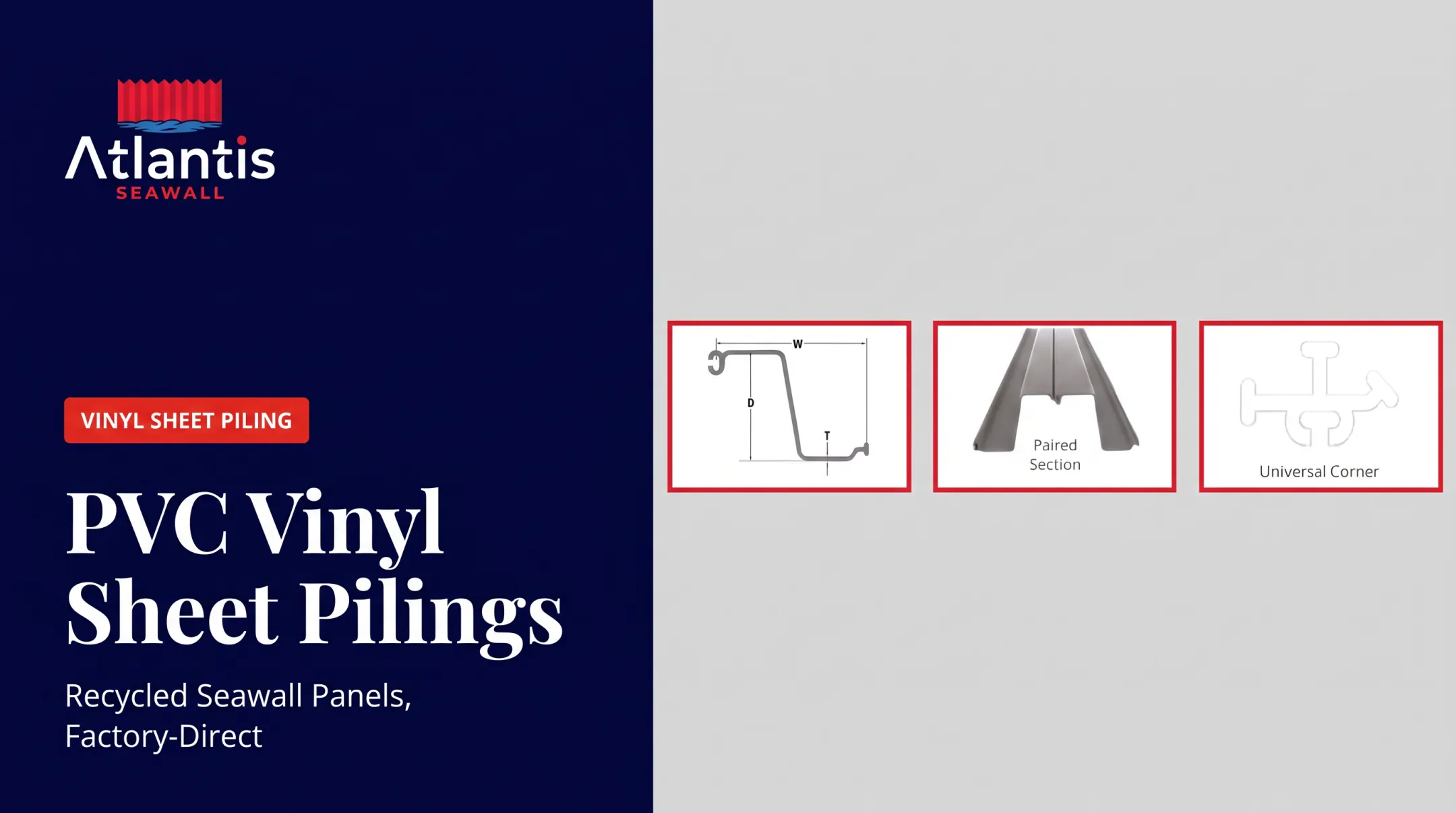
Atlantis Seawall manufactures recycled PVC vinyl sheet piling in Cleveland, Ohio and ships across the United States, typically within 5–7 days. Its 12-inch-wide, 9-inch-deep Z-profile weighs 5.5 lb/ft and uses a proprietary 100% recycled PVC blend with permanent interlocks.
Five grades (300 through 600) cover:
- Thicknesses from 0.300 to 0.620 in
- Section moduli from 20.25 to 41.85 in³/ft
- Allowable moments from 5,400 to 11,160 ft-lb/ft
Custom lengths come in one-foot increments with no charge for cuts, and a universal corner is available.
The 50-year limited transferable warranty requires approved engineering design, proper installation, normal conditions, and intended use. Its remedy is a prorated refund or replacement, excluding labor.
Atlantis coordinates installation through partner contractors rather than installing directly. Confirm current specifications before ordering. If your project needs FRP, evaluate it against FRP product data instead.
Frequently Asked Questions
What is composite sheet piling?
Composite sheet piling is a set of interlocking panels installed to form a retaining wall. FRP composites use glass fibers in a polymer matrix, while PVC or vinyl piling is a rigid polymer profile.
Are composite sheet piles good for seawalls?
They resist corrosion and rot, need little maintenance, and are light to handle. Structural suitability still depends on site loads, height, and engineering review.
What is the difference between FRP and vinyl sheet piling?
FRP contains reinforcing fibers, while vinyl is unreinforced PVC. They differ in stiffness, strength, weight, and wall-height capability, so use product-specific engineering data.
How long do composite sheet piles last?
Service life varies by material, exposure, design, and installation. Warranties (such as 50 years for vinyl) and manufacturer life claims (75+ years for FRP) are not the same as verified field performance, so read the terms closely.
Can composite sheet piling be used in saltwater and freshwater?
Many systems work in both environments, and FRP resin is chosen for the chemical exposure. UV, impact, soil, water chemistry, and loads still need evaluation.
How do you choose the right composite sheet piling for a seawall?
Start with wall height, soils, water and wave conditions, surcharge, drainage, embedment, anchoring, and permits. Then compare product data and have a qualified engineer review the design.