Introduction
A cracked cap or a small depression behind the wall looks like a cosmetic problem. Often it isn't. Those symptoms can point to soil leaving through failed joints, water pressure building behind the wall, or scour undermining the base.
Seawall restoration is not one procedure. It ranges from sealing cracks and filling voids to refacing or full replacement, and the right choice depends on what is actually failing.
This guide covers warning signs, inspection, restoration steps, material selection, cost drivers, timing, permitting, and maintenance. Atlantis Seawall manufactures recycled-PVC vinyl sheet piling in Cleveland, Ohio, for contractors and waterfront owners facing these repairs.
Key Takeaways
- Start with a condition assessment covering movement, water intrusion, soil loss, and drainage.
- Match the fix to the wall: spot repair, restoration, refacing, or replacement.
- Treat drainage, backfill, caps, anchors, and toe protection as part of the system.
- Compare bids by scope, engineering, permits, and exclusions, not panel price alone.
What Is Seawall Restoration?
Repair, restoration, refacing, and replacement
These terms overlap in the industry, so here is a working set:
- Repair: fixes isolated defects, such as grouting small cracks or replacing tie-rod end caps.
- Restoration: addresses several connected problems, such as void filling plus base protection.
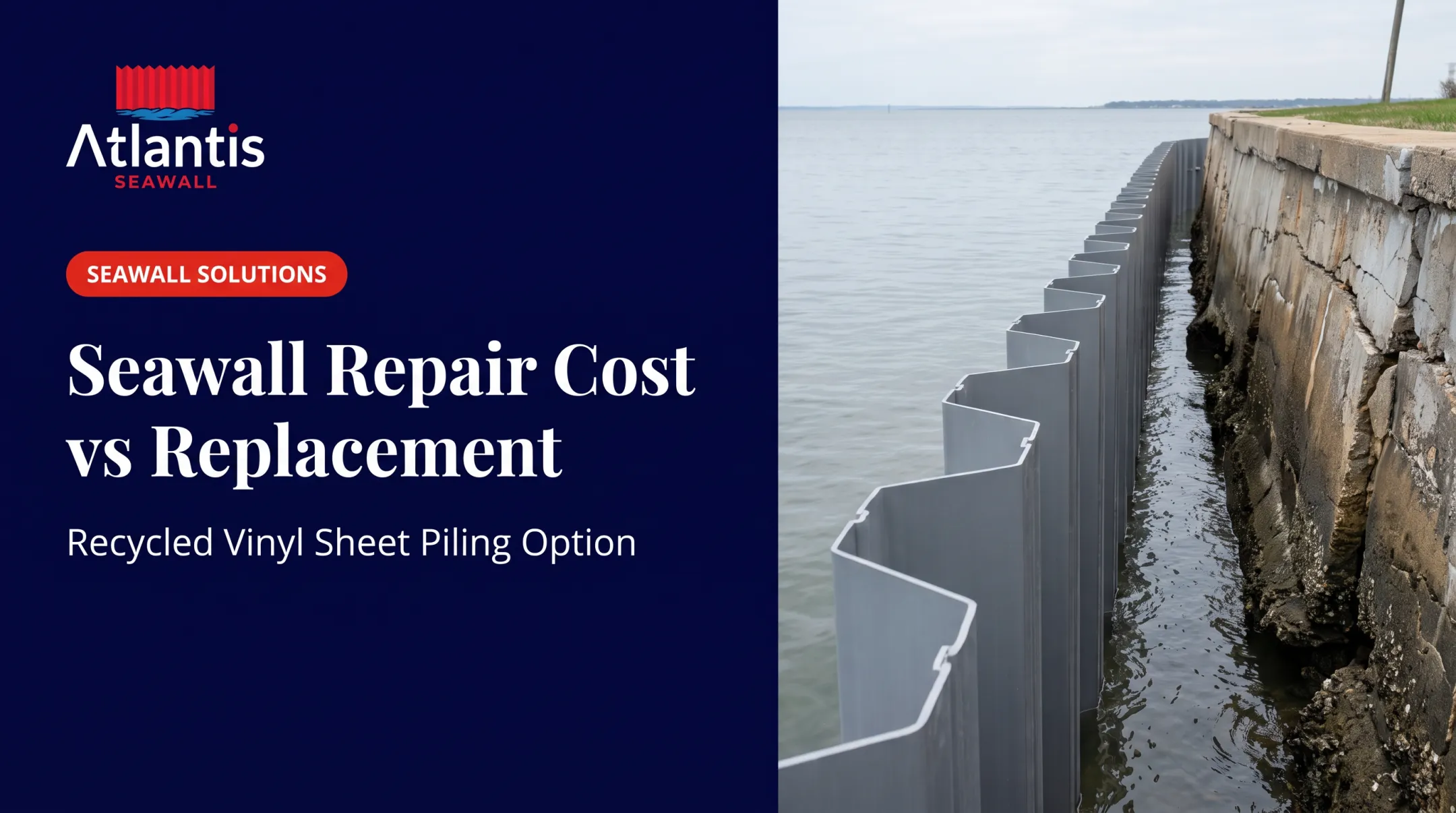
- Refacing: adds a new wall in front of an existing one where conditions allow.
- Replacement: removes or supersedes a failed structure.
The goal is restored shoreline protection and structural performance, not concealed cracks.
A Los Angeles County investigation of Marina del Rey found voids along about 17,600 linear feet, roughly 45% of the seawall. The county's program sealed 1/16- to 1/8-inch cracks by grout injection, proposed void filling, and added rock slope protection at the wall base. Those are project examples, not universal specifications.
Why seawalls need restoration
A wall resists wave action, water-level changes, and soil pressure while holding back the land. FEMA's 2024 coastal guidance treats breaking-wave forces, saturated soils behind the wall, and toe scour as design conditions.
That performance erodes over time from:
- Failed joints and poor drainage
- Soil migration and settlement
- Material deterioration
- Storm damage
Where restoration applies
Common settings include:
- Lakeshores, rivers, and canals
- Ponds and retention basins
- Marinas, campgrounds, and oceanfront lots
Wall height, soil, exposure, environmental rules, and equipment access vary by site and drive the design.
When Does a Seawall Need Restoration?
Land-side warning signs
Walk the property and look for:
- Cracks in the cap, pavement, or patio
- Sinkholes, depressions, or pooling water
- Exposed backfill or soil loss
- Leaning, bowing, or settlement
- Seepage through or behind the wall
Sinkholes or voids behind a bulkhead can indicate fill loss, according to a NOAA inspection guide. Sudden movement, fast-growing voids, active erosion, or a wall that seems to rotate needs a professional assessment, not a surface patch.
Water-side damage
From the water side, check for:
- Missing or displaced panels
- Open joints
- Corrosion, rot, or damaged caps
- Scour at the toe
Material-specific signs include:
- Steel: flaking, pitting, loose connections
- Concrete: spalling, delamination, exposed rebar
- Timber: rot, insect damage, splitting
A wall can look fine from the yard while damage below the waterline or behind it keeps undermining stability.
What causes deterioration
Environmental loads on the wall include:
- Storms, waves, boat wakes, and tides
- Runoff, groundwater, and freeze-thaw cycles
- Repeated wetting and drying
Site and construction issues compound those forces: poor drainage, hydrostatic pressure, soil migration, thin backfill, settlement, undersized components, and poor installation.
How an assessment works
A thorough review covers the face, cap, joints, anchors, drainage outlets, grading, backfill, toe, and adjacent structures.
Document:
- Wall length, height, and material
- Visible movement and erosion patterns
- Prior repairs and clear photographs
Bring in underwater inspection, geotechnical input, or a structural engineer when toe loss, hidden voids, or anchor problems are suspected. FEMA also recommends comparing against a baseline and inspecting after storms.
Choosing between repair and replacement
| Condition | Likely path |
|---|---|
| Localized, stable defects | Spot repair |
| Widespread leakage or soil loss | System restoration |
| Severe instability or degraded material | Refacing or replacement |
Weigh remaining structural capacity, site loads, access, permitting, life-cycle cost, and whether the old wall can safely stay in place during construction.
How Does Seawall Restoration Work?
Assessment and planning
The contractor or engineer turns findings into a defined scope, identifies the failure source, sets performance goals, and prioritizes urgent stabilization. They separate symptoms from causes. Sealing a crack does nothing if drainage or soil loss behind it continues.
Design, engineering, and permitting
Plans must address property lines, wall alignment, waterward work, environmental protections, and navigation or access concerns. Federal, state, and local layers can all apply:
- USACE Section 10 and Section 404 cover work in navigable waters and fill discharge.
- Nationwide Permit 13 covers eligible bank stabilization, including bulkheads and riprap, under its conditions.
- Ohio's ODNR may require a Shore Structure Permit along Lake Erie even where no USACE permit is needed.
- Michigan's EGLE says Great Lakes shoreline permit review may take 3-4 months.
Verify requirements with the relevant authority. They vary by waterway, state, project type, and jurisdiction.
Site preparation
Plan for the site factors that shape method and schedule:
- Equipment access and staging
- Utilities, docks, and landscaping
- Water levels and sediment control
- Work-zone safety
Tight access or high water can change the equipment, installation method, sequence, and timeline.
Repairs that restore the system
Depending on findings, the work may include:
- Joint and crack sealing
- Cap repairs
- Drainage improvements
- Backfill replacement and void filling
- Tieback or anchor repairs
- Erosion protection at the toe
Grout or polyurethane injection suits specific voids, leaks, and soils. Qualified professionals should choose the material and injection pressures.
Refacing or replacement
A new wall may go in front of the old one, or damaged sections may need removal. A Long Beach feasibility study evaluated a new sheet-pile wall waterward of an existing wall, and found that old concrete, debris, and soft soils constrained work close to it.
The typical sequence:
- Set out the alignment.
- Install or drive panels.
- Connect interlocks and corners.
- Complete caps and structural connections.
- Restore backfill, drainage, and grading.

Verification and maintenance
Before closeout, check alignment, connections, caps, drainage, backfill, erosion protection, and compliance with the approved design.
Then keep a simple routine:
- Inspect after storms
- Watch for new settlement or seepage
- Clear drainage paths
- Log changes and fix small defects early
Choosing Materials and a Restoration Approach
How common materials compare
| Material | What to watch |
|---|---|
| Steel | Corrosion, pitting, loose connections |
| Concrete | Cracking, spalling, exposed rebar |
| Timber | Rot, insects, hardware failure |
| Vinyl (PVC) | Must meet design loads and specifications |
| Composite (FRP) | Anchorage and deflection requirements |
| Riprap | Toe-scour analysis; can affect nearby habitat |
No independent, directly comparable service-life data exists for all of these, so be wary of universal lifespan claims. For vinyl, a 2023 federal specification covers PVC and FRP sheet piling, and ASTM D8427 covers rigid PVC profiles used for sheet piling.
What determines the best material
Site conditions drive the choice:
- Water chemistry and freeze-thaw exposure
- Wall height, soil strength, and retained loads
- Wave and wake energy
- Access, equipment limits, and environmental constraints
- Budget and long-term maintenance goals
The best material is site-specific. Choose the product after assessment and design, not before.
When vinyl sheet piling fits
Vinyl suits projects that value lightweight handling, lower installation vibration, resistance to rot and rust, and low maintenance.
Atlantis Seawall is an Ohio-based manufacturer and supplier of USA-made recycled PVC sheet piling, shipped across the United States. Its 400 Series uses:
- A 12-inch-wide by 9-inch-deep Z-channel profile
- 5.5-pound-per-foot panels
- Permanent interlocks and universal corners
- Custom lengths
- A 50-year limited transferable warranty
Atlantis says that, depending on soil, installers can drive 2-3 panels at once. Its warranty applies only under approved engineering design and proper use, and it excludes storms, normal wear, and faulty installation. A warranty is also not a service-life guarantee.

The system matters more than the panel
These parts of the wall system all carry load:
- Embedment, caps, and tiebacks
- Drainage, filter materials, and backfill
- Corners, transitions, and toe protection
- Dock connections
A durable panel still underperforms if water pressure, soil loss, or alignment remain unaddressed.
Evaluating products
Before you buy, review:
- Engineering data and installation requirements
- Warranty terms, available lengths, and profiles
- Delivery conditions and fit with project specifications
- Full installed and maintained cost, not just panel price
Atlantis supplies materials and coordinates installation through partners in Ohio, but does not offer standalone repair services.
How Much Does Seawall Restoration Cost and How Long Does It Take?
Cost factors
Cost depends on several project variables:
- Wall length, height, and damage extent
- Material, labor, access, and equipment needs
- Water conditions, engineering, and permits
- Demolition, disposal, backfill, and drainage
- Environmental controls and dock or landscape restoration
A San Diego report from May 2024 shows how wide the range runs:
| Scope | Estimate |
|---|---|
| Temporary void grouting | $146/LF |
| Parapet replacement | $585/LF |
| New seawall segment | $3,723/LF |

These are project-specific estimates that exclude design and construction management. They are not a national benchmark. Material-only prices also differ from fully installed cost.
Timelines
Several factors shape the schedule:
- Inspection findings and design complexity
- Permitting, material availability, and access
- Weather, water levels, and environmental restrictions
Emergency stabilization moves faster than full restoration.
Permit review alone varies: one USACE district aims to authorize nationwide permit requests within 45-60 days of a complete application, while Michigan cites 3-4 months. Treat timelines as planning factors, not guarantees.
Comparing bids and planning maintenance
Request an itemized scope listing:
- Restoration method and materials
- Design responsibility and permits
- Site preparation, drainage, and backfill work
- Warranty terms and exclusions
- Cleanup and follow-up inspections
Then weigh life-cycle cost, expected maintenance, post-storm monitoring, and the contractor's experience with your waterway and wall type.
Frequently Asked Questions
How much does it cost to rebuild a seawall?
It varies with wall dimensions, material, damage, access, engineering, permits, water conditions, and scope. Ask for an itemized, site-specific estimate.
How much do vinyl seawall panels cost?
Panel-only pricing differs from installed cost. Compare profile, length, shipping, accessories, labor, engineering, and site preparation.
What is the cheapest way to build a seawall?
The lowest material price may not give the lowest life-cycle cost. Compare installation, drainage, maintenance, and expected performance for your site.
What is the best material to use for a seawall?
It depends on water exposure, soil, loads, access, permits, budget, and maintenance goals. Vinyl, steel, concrete, timber, composite, and riprap each suit different conditions.
What are the 8 types of seawalls?
Classifications vary by material, structure, or application. FEMA lists gravity seawalls, pile-supported seawalls, and anchored bulkheads, and treats revetments separately. No single eight-item list is universal.
How long do vinyl seawalls last?
Service life depends on design, installation, exposure, soil, loading, and maintenance. Atlantis offers a 50-year limited transferable warranty, separate from any service-life estimate.