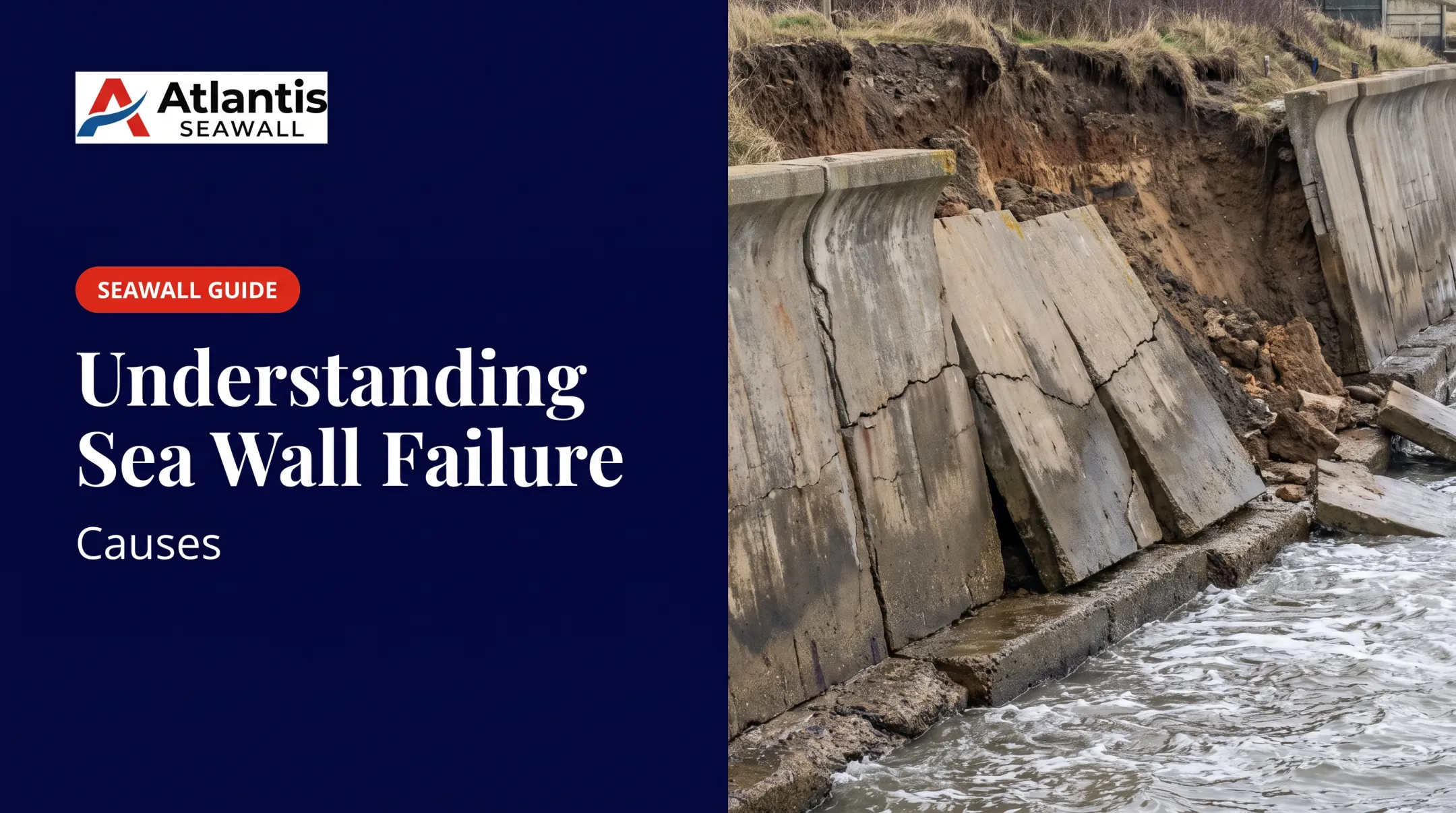
Skipping maintenance gets expensive. Ohio's Lake Erie design guidance warns that runoff and groundwater can erode fill behind a structure, create voids, and contribute to partial collapse. The same Ohio Coastal Design Manual notes that repairing a failed structure may cost as much as building it originally.
This guide covers lifespan by material, what shortens or extends service life, the types of maintenance, warning signs, inspection timing, and when to repair versus replace.
Key Takeaways
- Treat any lifespan figure as an estimate, not a guarantee.
- Inspections, working drainage, and prompt repairs keep small problems from becoming failures.
- Leaning, bowing, soil washout, scour, corrosion, and failed tie-backs need a professional.
- Inspect more often after storms, flooding, or heavy boat traffic.
How Long Do Seawalls Last? Why Maintenance Matters
Maintenance protects the shoreline, the stability of your property, safe access to the water, and the money you spent building the wall. A wall that is checked and fixed early stays useful longer than one ignored until something visibly gives.
Lifespan by Seawall Material
A current material-by-material lifespan table is hard to pin down. Available figures are often dated or limited, so treat the ranges below as context rather than promises.
| Material | What the evidence says |
|---|---|
| Wood | A 1996 Rutgers/NJDEP white paper reports creosote-treated lumber lasting roughly 30 years if properly maintained |
| Steel | No reliable public service-life range; have an engineer assess condition |
| Concrete | Fort Lauderdale's 2024 survey found many walls stable but nearing original design life, with remaining life hard to quantify |
| Vinyl | A 2003 Army Corps field study found about 10-year-old installations without significant material degradation; it did not set a lifespan |
| Riprap | The same 1996 paper says a well-designed revetment may last 30 years or more on average |
A Broward County brochure offers a broad Florida figure of 30 to 50 years depending on material. Treat it as a general estimate, not a table or warranty.
Warranty, Service Life, and Remaining Life
These are three different things:
- Warranty: a manufacturer's written promise about defects over a set period, with exclusions.
- Design or service life: the period a wall is engineered to perform when built and maintained properly.
- Remaining life: what is left in an older wall, which only an inspection can estimate.
No range here is a guarantee.
Factors That Shorten or Extend Seawall Lifespan
Water, Weather, and Ground Conditions
- Waves and storms: FEMA notes large storms can erode the beach and undermine a seawall, and overtopping can strip out backfill.
- Ice and toe scour: Ohio's manual documents ice displacing stone and freeze-thaw fracturing, and calls toe protection necessary to limit scour.
- Saltwater: Naples' seawall owner's manual says saltwater corrosion can cause cap reinforcement or tie-back rod failure.
- Hydrostatic pressure: Filter layers and drainage relieve pressure and keep fine soil from migrating out.
Reliable figures for boat wakes, brackish water, UV, or high water tables are hard to pin down. Ask an engineer about your site rather than trusting a rule of thumb.
Design and Installation
Long-term stability comes from decisions made before the first panel goes in:
- Adequate embedment, and anchors or tie-backs sized for the loads
- Proper backfill, filters, and drainage
- Engineering suited to the site's geology and wave exposure
- Permits: in Ohio, Lake Erie shore structures need a permit from Ohio DNR before construction, and federal Section 404 may apply to fill in US waters
- Competent installation
Maintenance and Long-Term Value
FEMA recommends an inspection and maintenance program to keep a structure stable through its intended life. Ohio calls monitoring critical to long-term success.
Catching a cracked cap or blocked drain early costs far less than rebuilding after backfill loss. A known condition lets you budget for capital work instead of reacting to an emergency.
Where Vinyl Fits
Vinyl sheet piling suits many waterfront settings when site engineering and installation are sound. Advantages include:
- Resists rot and corrosion in constant water contact
- Handles easily because panels are lightweight
- Covered by ASTM D8427-21 for rigid PVC sheet piling profiles
Atlantis Seawall, based in Cleveland, makes 12-inch Z-profile panels from 100% recycled PVC, weighing 5.5 pounds per foot. Its limited transferable warranty runs 50 years against material and workmanship defects under normal conditions and approved engineering design. It excludes storms, misuse, normal wear and tear, and faulty installation. That is a warranty, not independent proof of a 50-year life.

Types of Maintenance for Seawalls
Maintenance is not one annual chore. It combines scheduled care, condition monitoring, timely repairs, and occasionally major rehabilitation.
Routine / Preventive Maintenance
- Walk the wall and inspect it visually on a schedule
- Clear drainage paths and weep holes
- Photograph and document cracks or movement
- Check exposed hardware and caps
- Control nearby vegetation
- Watch erosion at the toe and behind the wall
Routine care may be enough when the wall is stable and problems are isolated. "Low maintenance" never means maintenance-free.
Corrective / Reactive Maintenance
Typical triggers include:
- Damaged panels or leaking joints
- Isolated cracks or minor corrosion
- Blocked drains or displaced riprap
- Localized soil loss
Naples' manual notes that minor cracks may be handled with cap or berm repairs.
Relying on emergency repairs alone invites recurring damage, hidden backfill loss, climbing costs, and failure during a storm. Repair cost depends on material, damage extent, wall length, water access, equipment, and permitting. Get a written estimate rather than trusting a universal price.
Predictive / Condition-Based Maintenance
Track change over time with:
- Dated photos and crack or lean measurements
- Settlement observations and drainage performance
- Corrosion progress and post-storm checks
Fort Lauderdale's 2024 plan ranks walls by observed condition to support this approach.
Call a professional engineer if you see structural movement, voids, foundation scour, anchor failure, or trouble below the waterline.
Major / Overhaul Maintenance
Major work can include:
- Replacing multiple panels or rebuilding the cap
- Restoring backfill and drainage
- Replacing anchors or stabilizing the foundation
- Full wall replacement
Naples notes advanced failure may require new panels, cap, tie-backs, and deadman, which is effectively a new seawall.
Repeated patching, widespread corrosion, severe leaning, major soil loss, or a poor original design all point toward replacement. There is no universal threshold for when to replace, so get a site-specific scope and estimate.

How to Check If a Seawall Needs Maintenance
Inspections catch changing conditions early. Stay out of unstable areas, and leave underwater or structural repairs to qualified crews.
Performance or Structural Changes
Look for:
- Leaning, bowing, settlement, or shifting panels
- Widening joints, altered alignment, or new gaps at the wall, dock, cap, or ground
Naples, Florida guidance also flags a deteriorating cap, upper rotation, and wavy or sagging panels as signs of tie-back trouble.
Unusual Behavior or Operation
Investigate:
- New water moving through the wall
- Sudden drainage changes or recurring flooding behind it
- Vibration from nearby activity
- Movement after boat wakes and storms
Visible Wear and Damage
Document:
- Cracks, spalling, exposed reinforcement, rust, or section loss
- Damaged vinyl interlocks or displaced rocks
- Deteriorated caps and impact damage
Soil Loss, Drainage Problems, or Scour
Check for:
- Sinkholes, depressions, or voids behind the wall
- Muddy discharge or soil washing through joints
- Exposed foundations or erosion at the base
- Blocked weep holes
These often mean support is disappearing behind or beneath the wall.

Recurring Issues
Repeated patching, recurring leaks, or damage that returns after repairs usually signals a deeper design, drainage, foundation, or material problem.
| Condition | Response |
|---|---|
| Hairline cracks, minor staining, stable alignment | Monitor and photograph |
| Blocked weep holes, isolated damaged panel, small localized soil loss | Localized repair |
| Leaning, bowing, sinkholes, scour, failed tie-backs, soil washout | Contact a contractor or engineer immediately |
Seawall Maintenance Schedule (General Guidelines)
Adapt any schedule to the material, age, water exposure, wave and boat activity, climate, storm risk, and the original engineer's or manufacturer's recommendations. Ohio's manual sets one clear minimum: inspect at least once a year and document conditions. No federal or state standard sets a fixed post-storm interval, so the rest below is general practice.
Maintenance Frequency Table
| Frequency | What to check |
|---|---|
| Daily or per use (active facilities) | Visible changes, damage, unusual movement |
| Weekly or periodic | Drains, weep holes, debris |
| Monthly or quarterly | Cracks, movement, erosion, hardware |
| Annually or longer | Professional inspection |
| After a storm or flood | New cracks, lean, soil loss, scour, damaged caps, displaced riprap, changes below the waterline |
Usage and Environment Adjustments
Marinas, exposed shorelines, saltwater sites, older walls, and heavy boat traffic call for more frequent checks than a lightly used freshwater lot.
Keep an inspection log with photos, dates, observed changes, repairs, contractor reports, and material and warranty documents. If a warranty claim ever arises, that record helps. Atlantis Seawall's warranty, for example, requires a claim within 30 days of discovering a defect, with proof of purchase and photos.
Conclusion
Lifespan depends on material, design, installation, site exposure, and maintenance. Regular inspections and early action protect safety, reliability, and property value.
If you are weighing replacement or new construction, Atlantis Seawall supplies recycled PVC vinyl sheet piling with custom lengths in 1-foot increments. Shipping runs across the United States, and installation is coordinated in Ohio. Reach the team at 216-550-5737 or Bob.F@seawallusa.com.
Frequently Asked Questions
How much does it cost to repair a seawall?
It varies with material, damage severity, wall length, water access, soil and drainage conditions, permitting, equipment, and whether anchors or backfill need restoring. Get a site inspection and a written estimate.
What is the average lifespan of a seawall?
It depends on material and environment, so no single figure applies. See the material comparison above for typical ranges by material.
How long does a seawall last in Florida?
Saltwater, storms, heat, high water tables, soil, and boat traffic all affect it. Don't apply a Florida estimate automatically to freshwater or Great Lakes sites.
How long does a vinyl seawall last?
It depends on formulation, thickness and profile, embedment, anchoring, UV and water exposure, soil pressure, installation, and maintenance. A manufacturer warranty is not the same as expected life.
What are the 8 types of seawalls?
Terminology varies, and some categories describe materials while others describe designs. Common ones are concrete, steel, vinyl, wood, riprap, masonry, sheet-pile (anchored or cantilevered), and living or hybrid shorelines.