
Introduction
A waterfront property owner usually faces the same question: patch the wall for less money now, or replace it and stop chasing problems. Repair costs less up front. Replacement may be the more reliable choice once a wall has lost structural stability.
The answer depends on wall length, height, material, damage severity, water and soil conditions, access, engineering, permits, and disposal. No single price per foot settles it.
This article gives you a decision framework. You'll compare current cost, remaining service life, failure risk, maintenance needs, and the scope of work in each quote.
Key Takeaways
- Repair isolated damage on a stable wall; replace if you see movement, soil loss, failed anchors, or repeat failures.
- Treat per-foot figures as rough benchmarks until a site inspection confirms conditions.
- Compare lifecycle cost, not just the lowest first bid.
- Choose materials, including vinyl sheet piling, on engineering needs and exposure.
What Seawall Repair and Replacement Actually Involve
Repair and replacement address different levels of failure
Repair is targeted work that keeps most of the existing wall: patching, joint work, cap repairs, tieback reinforcement, void filling, or replacing limited sections.
Replacement means removing or abandoning the existing system and installing a new one. That can include panels, piles, anchors, caps, backfill, drainage, and shoreline work.
Fixing only the visible face rarely works if the real problem is failed support, drainage, soil, or anchoring. Massachusetts guidance says repairs should address every erosion source, including upland runoff and waves. Erosion behind the wall, sinkholes, and poor drainage build pressure that contributes to failure.
What a repair estimate may include
Common repair scopes:
- Crack and spall treatment
- Joint sealing and cap repair
- Localized panel replacement
- Tieback work and grouting
- Erosion control
- Clearing blocked drainage paths
A good quote states whether the work is cosmetic, structural, or temporary stabilization. It should also say whether anyone inspects below the waterline.
What a replacement estimate may include
Common replacement scopes:
- Demolition or removal, and disposal
- New wall material and installation equipment
- Structural design and anchoring
- Drainage and backfill stabilization
- Cap construction
- Site restoration and permitting
Replacement also lets you fix a poor original design, improve drainage, pick a lower-maintenance material, or prepare for a planned dock.
Material choice and Atlantis Seawall's option
Each material has a known weak point:
| Material | Main exposure concern |
|---|---|
| Wood | Rot and marine-borer attack in seawater |
| Steel | Corrosion and pitting, including in freshwater |
| Concrete | Cracking and leaching; needs suitable mixes for severe exposure |
| Vinyl (PVC) | Long-term creep under sustained load requires engineering |
A seawall study in Oxnard, California noted timber piles in seawater are vulnerable to marine borers. Wisconsin Sea Grant has documented deep pitting in Lake Superior steel structures.
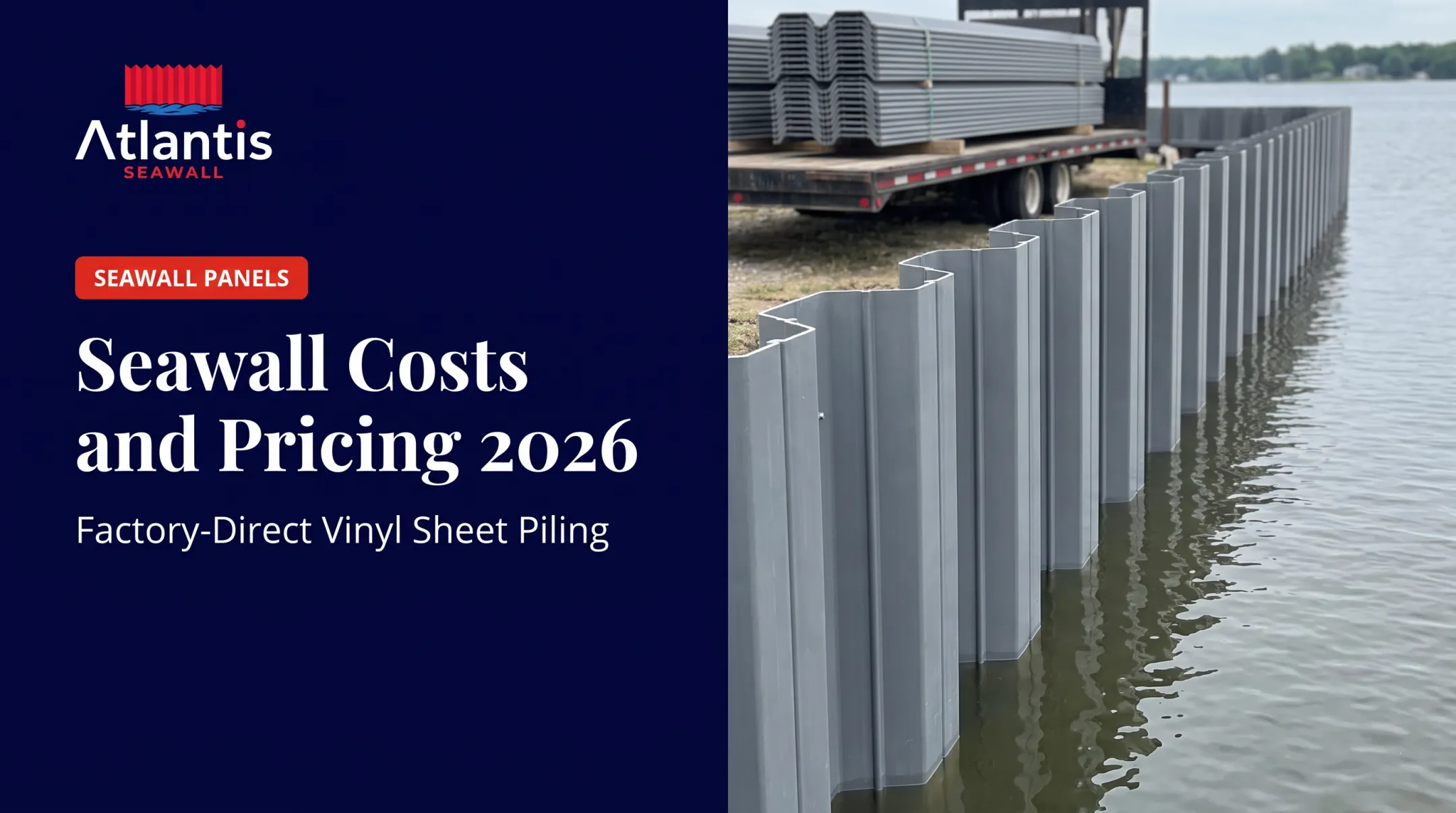
Vinyl avoids rot and corrosion, which is why it is a common choice for full replacement. Atlantis Seawall manufactures recycled PVC vinyl sheet piling in Cleveland, Ohio, for new and replacement walls.
Panels are 12 inches wide and 9 inches deep, in 300 to 600 duty grades. Request current product documentation for engineering specifications, lengths, installation requirements, and warranty terms. Atlantis ships across the United States and coordinates installation in Ohio through local partner installers.
How Much Does Seawall Repair Cost vs. Replacement?
Current U.S. cost benchmarks
No authoritative national per-linear-foot range for repair or replacement exists, so treat any quoted range with caution. Public projects show scale, not homeowner pricing:
| Project | Published cost | What's included |
|---|---|---|
| Fort Lauderdale, FL (2022) | $2,954,062 for about 790 linear feet | Seawall replacement plus stormwater and drainage work |
| Tacoma, WA (2022 bid) | $4,144,405 | Bulkhead replacement at multiple sites |
| Sarasota, FL (2026) | $5,569,022 for about 1,506 linear feet | Reconstruction, raised cap and grades, drainage |
Don't divide these totals into a per-foot price. Each bundles different scopes, locations, and related work.
That's also why published ranges vary so much. One source counts only materials or a localized fix. Another includes engineering, demolition, access, permits, equipment, and restoration.
Repair cost categories
Lower-complexity repairs include minor crack or joint treatment and cap work. Structural repairs cost more because they may need marine equipment, excavation, underwater work, specialized anchoring, or heavy backfill:
- Localized panel replacement
- Tieback or anchor work
- Soil stabilization and void filling
- Erosion correction
Replacement cost categories
Tacoma's bid schedule itemized lines such as:
- Mobilization and demolition
- Drawings and sheet piles
- Utility penetrations and excavation
- Surfacing and French drains
Your quote will likely break out similar lines.
Costs climb when the new wall must be taller, deeper, or stronger than the original, or built for more wave, current, vessel, or soil pressure.
Short-term price versus lifecycle value
A municipal feasibility study states that design lives of 50 to 75 years are generally obtainable for new construction. That's a design prediction, not a guarantee.
Consider a simple example. Suppose a $15,000 repair buys 5 years before the next failure, and a $60,000 replacement is designed for 50 years.
That equals about:
- Repair: $3,000 a year
- Replacement: $1,200 a year, before maintenance
Your numbers will differ, but run this math with real quotes.
A cheap repair is poor value when it treats symptoms and leaves a failing system in place.

When Repair Makes Sense, and When Replacement Is Better
Conditions that may support repair
Repair makes sense when the wall is plumb and stable, damage is local, the soil is intact, anchors still work, and the contractor can find and correct the cause. Examples:
- Isolated cap deterioration
- Limited cracking or spalling
- Blocked drainage openings
- Small areas of corrosion
- Localized joint failure
- A few damaged panels
Conditions that commonly support replacement
- Widespread leaning, bowing, buckling, or collapse
- Major panel failure or extensive corrosion
- Failed tiebacks
- Severe scour, large voids, or sinkholes
- Substantial backfill loss
- Repeated repairs or rapidly worsening movement
- A wall near the end of its service life
In these cases, get a replacement comparison before approving another patch.
Hidden damage and structural evaluation
Much of the damage can't be seen. NOAA documents scour undermining sheet piling and sinkholes from fill loss behind bulkheads. Water pressure, damaged anchors, and clogged drainage weaken a wall from the inside.
If the wall is moving, soil is eroding, or the cause is unclear, bring in a qualified marine contractor, structural engineer, or geotechnical professional. Massachusetts recommends a coastal engineer for site-specific repair advice. NOAA's guide says underwater inspections should be done by trained engineer-diver teams.
Wall age, environment, and remaining service life
Service life is not fixed by material type alone. Actual performance depends on installation quality, maintenance, fresh or salt water, waves and currents, freeze-thaw cycles, soil movement, and impact.
Age alone shouldn't decide the project. But an older wall showing several structural symptoms deserves a replacement analysis.

A practical decision rule
- Repair when the structure is stable and the damage is limited and correctable.
- Compare replacement when repairs are extensive, recurring, or approaching the cost of a new system.
- Rely on a documented inspection, not a rigid percentage rule.
What Changes the Final Project Cost?
Wall dimensions, site conditions, and water exposure
Length, height, embedment depth, and thickness drive material and installation needs. So do water depth, shoreline shape, soil type, groundwater, current, waves, vessel activity, and fresh versus salt exposure.
A tall wall in soft soil with wave action costs far more than a short one in firm ground.
Access, equipment, labor, and logistics
- Land access and narrow shorelines
- Neighboring docks and obstructions
- Staging space
- Barge or crane needs
- Seasonal work windows
- Material delivery and disposal
- Divers, waders, or specialized marine equipment
Delivery matters too. Atlantis ships from Cleveland within 5 to 7 days, and full truckloads of 7,000+ square feet ship free. Its panels can be driven two or three at a time, depending on soil, which reduces vibration.
Engineering, permitting, and related work
Permits vary by location. Federal Nationwide Permit 3 can cover repair or replacement of a currently serviceable structure, but not one so degraded it essentially needs reconstruction. It doesn't remove state or local requirements.
Florida requires a coastal construction permit for seawalls on covered lands. North Carolina limits replacement alignment to 2 feet waterward of the current wall.
Expect separate line items for:
- Engineering and environmental review
- Permits, demolition, and disposal
- Drainage, backfill, and landscaping
- Dock removal and restoration

How to Plan and Compare Seawall Work
Start with a documented inspection
Before requesting bids, gather:
- Dated photos and measurements
- Visible movement and drainage conditions
- Evidence of erosion or voids
- Wall material and installation history
- Prior repair records, drawings, and permits
A useful inspection report names the symptoms, likely causes, urgent safety concerns, repair options, replacement options, and limits on evaluating submerged or hidden parts. NOAA also recommends written summaries and photos so later inspections show how fast conditions change.
Compare complete written scopes
Check each quote for:
- Demolition and disposal
- Materials and panel or pile dimensions
- Anchors, tiebacks, drainage, and backfill
- Engineering and permits
- Equipment, labor, and site restoration
- Schedule and payment terms
- Warranty and exclusions
Get several qualified bids, but don't compare prices unless scopes, materials, and design assumptions match. Read warranties closely. Atlantis's 50-year limited transferable warranty, for example, requires approved engineering design and proper installation, excludes labor and reinstallation costs, and caps liability at the original purchase price.
Plan maintenance after the work
Ask about inspection intervals, drainage and vegetation upkeep, documentation requirements, and warranty exclusions. Learn which signs need prompt professional attention. NOAA suggests 2 to 6 years between routine inspections for harbor structures, more often as damage appears.
Safety note: Don't enter unstable areas, dig near a failing wall, or attempt structural repairs without the expertise, equipment, and approvals.
Frequently Asked Questions
What is the average cost to repair a seawall?
No reliable national average exists. Minor crack or joint work costs far less than structural repairs that need marine equipment or excavation. Length, material, access, and hidden damage drive the final quote.
What is the average lifespan of a seawall?
It varies by material and site. One feasibility study cites 50 to 75-year design lives for new construction. Water exposure, soil, installation quality, maintenance, and storms can shorten or extend that span.
What are the three types of seawalls?
There is no single official three-type list. Structurally, walls are often described as gravity, pile-supported, or anchored sheet-pile types. Wood, concrete, steel, and vinyl are materials, which is a separate classification.
How do I know whether to repair or replace my seawall?
Stable, localized damage suggests repair. Movement, widespread failure, soil loss, failed anchors, or recurring repairs call for a replacement assessment.
What factors affect seawall repair or replacement cost?
Wall dimensions, material, damage severity, access, water and soil conditions, equipment, engineering, permits, demolition, disposal, backfill, and restoration all affect the price.
Can a seawall be repaired instead of replaced?
Yes, when the main structure is stable and the cause is correctable. A qualified inspection should confirm the repair will last.