Introduction
Soil rarely leaves a seawall all at once. It slips out through failed joints, cracks, open wall ends, drainage openings, or gaps around pipes.
The first sign is often a small dip in the lawn. Behind that dip, a void is growing.
Seawall soil erosion control is not a single fill job. It combines diagnosis, drainage, backfill stabilization, wall repair or replacement, toe protection, vegetation management, and regular inspection. Skip one piece and the soil keeps leaving.
This guide walks through why erosion starts, how to spot it early, which control methods fit which problems, and how materials and permits factor in.
Key Takeaways
- Start by finding how water and soil move behind, through, and beneath the wall.
- Sinkholes, leaning, bulging, and seepage deserve investigation before they spread.
- Drainage, filters, sound backfill, and toe protection work as a system.
- Site conditions, wall material, and local permits decide the right fix.
Why Soil Erosion Develops Behind a Seawall
Landward soil loss versus toe scour
Two different failures can undermine a wall. Backfill loss removes retained soil on the land side through openings, overtopping, or wall ends. Toe scour removes support at the water-facing base and reduces how deeply the wall is embedded.
Federal engineering guidance treats them as separate problems. A surface that looks intact can still hide toe scour.
Common pathways for soil loss
- Separated joints and cracked panels in concrete walls, which let backfill escape into the water
- Weep or drainage holes without proper filters
- Wall ends exposed when the neighboring shoreline recedes (known as flanking)
- Poorly installed drainage pipes or other penetrations
- Water flowing beneath the wall, which can increase toe scour where exit gradients are steep
Not every interlock leaks. Sheet-pile interlocks are relatively soil-tight, so trouble usually sits at holes, ends, and damaged sections.
Forces that move soil
Hydrostatic pressure builds when groundwater and runoff can't drain. Wave overtopping, boat wakes, tides, and currents then carry fine particles away. FEMA identifies wave overtopping as a cause of backfill loss that can undermine structures on land.

Site and construction factors
- Poorly compacted backfill or mismatched soil layers
- Inadequate embedment or wall movement
- Clogged drainage
- Freeze-thaw cycles, particularly in silty soils that drain poorly
- Uncontrolled irrigation and surface runoff
Installation quality matters too. Atlantis Seawall's warranty excludes damage caused by faulty installation.
How to Identify Soil Erosion Early
Landward warning signs
Walk the property and look for:
- Depressions, sinkholes, and settling slabs
- Exposed roots and visible voids
- Cracking in nearby pavement
- Soil disappearing through joints
- Sudden grade changes behind the wall
Wall-side warning signs
Inspect the face of the wall for:
- Leaning, bulging, or separated panels
- Open interlocks and cracked caps
- Corrosion, rust marks, spalling, or exposed reinforcement
- Unusual seepage or blocked drainage openings
- Exposed sections of the wall base
Discharge alone doesn't prove failure. Drainage is supposed to release water. The concern is water that carries soil with it.
Document before you act
Take dated photos, measure depressions, and note water levels, storm conditions, boat traffic, and runoff. Don't attempt a structural repair based on a visual check alone.
When to call a professional
Bring in a qualified seawall contractor, marine engineer, or geotechnical specialist when voids are growing, structures are settling, the wall is moving, or erosion sits near utilities or foundations.
Guidance varies by state. Ohio DNR states that bulkhead design requires a professional engineer, and Massachusetts recommends a coastal engineer for repairs.
Effective Seawall Soil Erosion Control Methods
Diagnose the source before filling the void
Dumping soil into a sinkhole gives temporary relief at best. If water still escapes through the wall, beneath the toe, or along an open drainage path, the void returns.
Evaluate these conditions first:
- Wall alignment, joints, and ends
- Toe conditions and backfill
- Groundwater and surface drainage
- Nearby structures
Massachusetts guidance warns that cosmetic patches may not prevent storm failure.
Restore drainage behind the wall
Good drainage relieves hydrostatic pressure and keeps the soil in place. That requires filters, whether geotextile, graded stone, or an engineered drainage layer, behind every opening.
Don't seal, block, or enlarge drainage openings on your own. Have a professional evaluate their location, discharge, and filter protection.
In one documented case, a timber bulkhead in Oak Harbor, Washington lost backfill through gaps in its landward filter cloth. Once those defects were repaired, later performance improved and damage stayed limited.
Stabilize lost soil and fill voids
The right approach depends on void size, water movement, soil, and access:
- Compacted backfill placed in thin lifts
- Graded aggregate with filter fabric
- Flowable fill between walls, as proposed in a Boston stabilization design
- Grout under rock or armor toe protection, depending on footing elevation relative to tide
Whatever the method, it must close the pathway and restore support. Hiding the surface symptom is not a repair.

Repair, reinforce, or replace
Minor waterline cracks may be repairable. Advanced failure, such as widespread deterioration, failed connections, inadequate embedment, or recurring backfill loss, usually calls for a new wall system.
| Factor | Favors repair | Favors replacement |
|---|---|---|
| Structural condition | Localized defects | Widespread movement or deterioration |
| Soil loss | Small, traced to one source | Recurring or large voids |
| Service life | Substantial remaining | Largely used up |
| Access and exposure | Easy, moderate | Repeated repairs in harsh exposure |
| Long-term cost | Repair is cheaper over time | Repeat repairs add up |
Address toe scour and water energy
Scour at the base can strip support from beneath the wall while the lawn looks fine. Site-appropriate measures include:
- Riprap toe protection
- Engineered rock or a designed revetment
- Wave attenuation
Design must account for currents, waves, wakes, water depth, neighboring properties, and environmental rules.
Use vegetation or hybrid measures where appropriate
Native vegetation stabilizes upper-bank soil, slows runoff, and improves habitat. NOAA's living shoreline guidance supports wave damping on sheltered coasts, but no technique guarantees protection in the worst storms.
In high-energy settings, plants need structural help. At Edenhouse on North Carolina's Chowan River, a failing 400-foot bulkhead was replaced with regrading, a gapped stone sill, and planting. Full stabilization took a few years.
Choosing Materials and Designing for Long-Term Soil Retention
Compare common materials
| Material | Main concern |
|---|---|
| Wood | Rot; needs treated timber and marine fasteners |
| Steel | Corrosion, especially in the splash zone |
| Concrete | Cracking, spalling, rebar corrosion, freeze-thaw |
| Rock | Works only as a system with filters and toe support |
| Vinyl (PVC) | Deflection-controlled design; weatherable, UV-inhibited material |
Choose on engineering needs and site conditions, not the lowest purchase price.
Evaluating vinyl sheet piling
Atlantis Seawall manufactures vinyl sheet piling in Cleveland, Ohio. For contractors, builders, and suppliers building new seawalls or bulkheads, the product facts are:
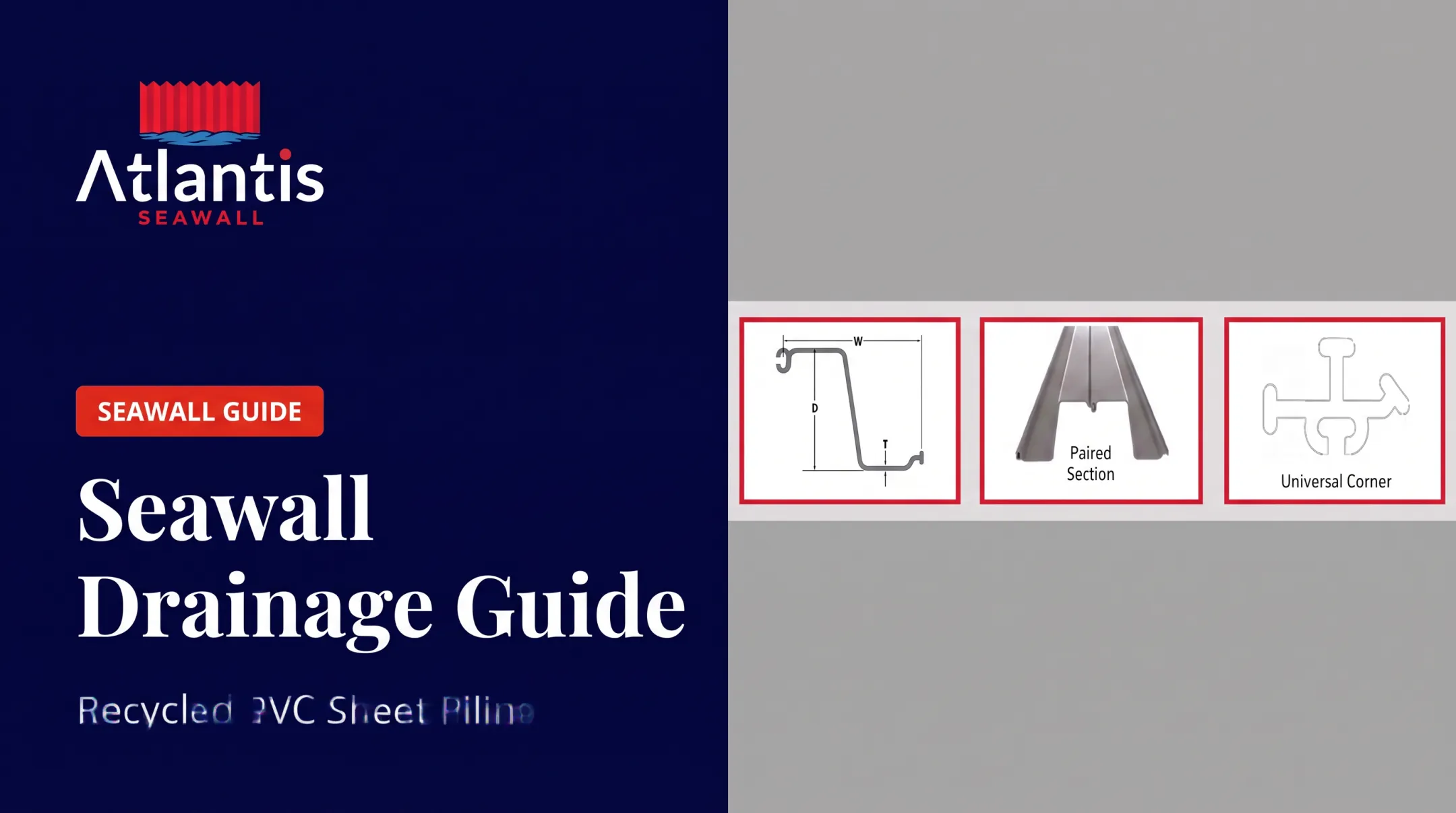
- 100% recycled PVC in a 12-inch-wide, 9-inch-deep Z-channel
- Lightweight at 5.5 pounds per foot
- Interlocks that pair sections permanently, plus a universal corner including a 45° option
- Standard lengths from 8 to 30 feet, with custom 1-foot increments
- 50-year limited transferable warranty
- Shipping across the United States, and installation support in Ohio through local partner contractors

A warranty is not the same as proven field life, and it applies only under approved engineering design and proper use. Final suitability depends on site-specific design.
Design for retention, drainage, and connections
Cover these before ordering anything:
- Embedment depth and wall height
- Interlocks, corners, and returns
- Caps, plus tiebacks or anchors where required
- Drainage, filter layers, and backfill
- Transitions at property lines
Weak connections, unprotected ends, missing filters, and abrupt changes between neighboring structures become concentrated erosion pathways.
Match the design to the waterfront
Site conditions that shape the wall include:
- Water body type, wake exposure, and current
- Water-level swings, flooding, and freeze-thaw
- Bank slope, soil, and groundwater
- Equipment access and nearby buildings or docks
Get a site assessment and engineering input where needed before buying materials.
Environmental and regulatory requirements
Coastal, lake, river, wetland, and floodplain projects face different layers of review, and no one state's rules apply everywhere.
- Federal: USACE regulates bulkheads in navigable waters under Section 10 and fill under Clean Water Act Section 404
- NWP 13: The 2026 Nationwide Permit 13 runs March 15, 2026 to March 14, 2031, with regional and state water-quality conditions
- State and local: Ohio reviews Lake Erie shore structures separately; Massachusetts often routes repairs through the local Conservation Commission; Snohomish County, WA requires shoreline permits and geotech analysis
- Floodways: Projects may need engineering analysis and a no-rise certification
Confirm requirements with your local authorities and the Corps district for your jurisdiction.
Maintenance, Drainage, Permitting, and Next Steps
Inspect and prevent
Inspect after major storms, high water, heavy runoff, unusual wake activity, and seasonal changes. Check for cracks, movement, scour, seepage, blocked drainage, new depressions, and vegetation changes. FEMA calls for inspection and maintenance throughout a wall's life but sets no universal interval.
Prevention is mostly housekeeping:
- Direct roof and surface runoff away from the wall
- Control irrigation
- Keep drainage outlets clear
- Maintain approved vegetation
- Repair small defects promptly
- Keep heavy loads off unstable backfill
Action plan
- Document symptoms with dated photos and measurements.
- Limit loading and disturbance near the wall.
- Get a qualified site assessment.
- Confirm permits and environmental requirements.
- Choose a repair or replacement strategy that fixes both the wall and the soil behind it.
If you're a contractor, builder, or supplier weighing vinyl sheet piling, Atlantis Seawall can answer product questions. Call (216) 550-5737 or email bob.F@seawallusa.com.
Frequently Asked Questions
How much does it cost to fix a seawall?
Cost depends on wall length and height, material, access, water conditions, soil loss, drainage and scour repairs, engineering, permits, and labor. Repair versus replacement matters most. Get a site-specific estimate.
Is there a way to stop coastal erosion?
Often it can be reduced substantially, not eliminated everywhere. Options include seawalls, revetments, living shorelines, drainage control, vegetation, and hybrids, designed around wave energy and environmental requirements.
What causes soil erosion behind a seawall?
Failed joints, wall movement, water pressure, runoff, overtopping, poor backfill, missing filters, clogged drainage, and scour beneath or around the wall.
How do I know if my seawall is failing?
Watch for leaning, bulging, cracks, open joints, sinkholes, settlement, seepage, exposed toe sections, and soil vanishing through the wall. Progressive or structural symptoms warrant prompt professional evaluation.
Can vegetation help prevent erosion behind a seawall?
Native plants can stabilize upper-bank soil and slow runoff. They shouldn't block drainage or replace structural repair where wave energy, scour, or wall movement is significant.
Should I repair or replace my seawall?
It depends on structural condition, movement, soil loss, remaining service life, material deterioration, repair history, exposure, regulations, and long-term cost. Minor, localized defects can be repaired. Advanced failure usually needs replacement.