
Introduction
There is no single way to install a pile. The right method depends on soil, pile type, structural purpose, equipment access, design loads, and environmental limits.
A method that works for a steel H-pile in dense sand can wreck a precast concrete pile or disturb a neighboring foundation.
The Federal Highway Administration's driven pile manual is a common starting point. It ties foundation selection to subsurface data, project constraints, auxiliary equipment, and load transfer.
This guide covers impact driving, vibrodriving, press-in installation, drilling, jetting, pre-augering, and sheet pile sequences. Final methods should always follow the engineered plans and project specifications.
Key Takeaways
- Installation methods fall into driven, pressed, drilled, and assisted approaches.
- Impact, vibratory, and press-in methods trade off speed, noise, vibration, and capacity verification.
- Sheet piling for seawalls works differently from bearing piles under buildings or bridges.
- Soil data, alignment control, records, and verification decide project performance.
Piling in Construction: Purpose, Pile Types, and Terminology
What Piles Do in Construction
Piles carry structural or lateral loads through weak near-surface soils into deeper layers, rock, or surrounding ground resistance. They serve three distinct roles:
- Individual foundation piles carry a column or structure load
- Pile groups share heavy loads under a cap
- Interlocking sheet piles form retaining, cutoff, seawall, and bulkhead walls
How Piles Are Classified
How many “main types” exist depends on the classification system. Piles can be grouped by installation method, material, function, or geometry.
By installation, the broad categories are:
- Driven piles
- Bored or drilled piles
- Screw or helical piles
FHWA distinguishes driven piles from drilled shafts. ICC-ES describes helical shafts as screwed into soil by torsion.
End bearing, friction, and combined behavior describe how load transfers. They are not installation methods.
| Material | Practical notes |
|---|---|
| Steel H-pile | Suited to toe bearing on rock; corrosion can reduce resistance |
| Prestressed concrete | Durable against weathering, but vulnerable to damage from hard layers and obstructions |
| Timber | Fits modest friction loads in sand, silt, and clay; poor in dense gravel, boulders, or till |
| Composite | Weakest material governs structural design |
| PVC/FRP sheet | Retaining-wall systems, not deep foundation piles |
Match material to soil, load path, and exposure rather than defaulting to one pile type for every site.
Main Piling Installation Methods
Method selection balances several project factors:
- Ground resistance and required embedment
- Pile material and installation tolerances
- Site access, plus noise and vibration limits
- Need to verify capacity after installation
Impact Driving vs. Vibrodriving
Impact driving uses repeated hammer blows from air, hydraulic, or diesel hammers. It works across pile types and pairs well with blow-count criteria.
Vibrodriving clamps the pile and vibrates it, reducing side resistance. It performs best in granular soils, especially submerged ones, and struggles in stiff or hard clay. FHWA cautions against it for precast concrete piles and notes that vibration installation alone does not reliably establish nominal resistance.
Press-In or Hydraulic Jacking
Press-in rigs clamp a sheet pile and push it down with static force, reacting against piles already installed. PDCA says this avoids impact-driving noise and vibration. That does not mean silence or zero environmental effect.
Limits are practical: the rig must match the pile section and project layout, and it needs access along the wall line.
Drilling, Bored Piles, and Predrilling
Drilled shafts follow a clear sequence:
- Excavate the shaft
- Stabilize with fluid or casing
- Clean and inspect the base
- Place reinforcement
- Place concrete (tremie concrete displaces slurry upward)

Designs may instead call for grout or a prefabricated pile.
Drilling or predrilling suits rock, obstructions, dense strata, sensitive neighbors, and sites where direct driving is impractical.
Driving Assistance Methods
Jetting helps penetration in loose to medium-dense granular soil. FHWA does not recommend it for friction piles because it reduces frictional resistance, and it advises impact driving to required resistance after the jets are removed.
Pre-augering can ease driving, limit vibration, pass obstructions, or reduce heave. The hole must still leave enough soil support.
In an FHWA Central Artery/Tunnel case, pre-augering and wick drains did not prevent adjacent-building movement. Over-removal of soil can also hurt skin friction, interlock friction, settlement, groundwater movement, and wall stability.
Sheet Pile Installation Sequences
- Pitch-and-drive: sheets go in individually to final depth. ArcelorMittal calls it common in loose to medium-dense soils and short piles, though the leading interlock may deflect.
- Panel driving: several interlocked sheets are assembled and advanced in stages with guides or templates. ArcelorMittal and NASSPA both recommend it for dense sand or gravel, stiff cohesive soil, and obstructions.
Panel driving improves plumbness and reduces forward and backward lean. Pitch-and-drive remains useful for shorter piles and certain press-in systems.
Step-by-Step Piling Installation Process
Site Investigation and Engineering Review
Begin with a full site review covering:
- Geotechnical data and groundwater conditions
- Existing structures, utilities, and access
- Design loads, embedment, and permit requirements
USACE recommends early investigation along sheet-wall alignments to inform wall type and depth, earth pressures, groundwater, and settlement risk. IBC 2024 calls for deep-foundation investigations that list recommended types, capacities, driving criteria, and installation procedures. Local adoption governs.
Where soils vary or behavior is uncertain, test piles, probe piles, load testing, or driveability analysis may be appropriate.
Project Preparation and Equipment Selection
Select pile material, length, and profile first. Then match equipment to the job:
- Hammer or press, and drilling rig
- Crane or barge support
- Templates, leads, and cushions
- Jetting systems and survey gear
The working platform matters as much as the rig. OSHA's crane rules require firm, drained, graded ground that supports the equipment, with added support materials where needed.
Layout, Alignment, and Initial Positioning
Crews set the pile line, elevations, spacing, corners, batter angles, and connection points first. Templates, guide frames, leads, and surveying instruments then control position, plumbness, interlock engagement, and wall geometry.
USACE calls for at least two templates per pile or pair.
Installation and Sequencing
The crew advances each pile or panel while watching penetration, alignment, hammer or press performance, refusal, and signs of damage.
For sheet piles, sequence matters. Keep interlocks engaged, manage forward lean, and correct small errors early so they do not accumulate along the wall.
ArcelorMittal attributes forward lean mainly to soft soil where interlock friction exceeds resistance at the free end. Treat this as one manufacturer's explanation rather than a universal rule.
Verification and Completion
Confirm final elevation, embedment, driving resistance, and refusal criteria. Complete any specified load or integrity testing, then handle cut-offs, connections, bracing, capping, drainage, and backfill.

FHWA describes blow-count criteria, static tests, dynamic tests, rapid load tests, and wave-equation analysis. The foundation designer specifies which applies.
Installation records should capture:
- Pile identification and location
- Equipment and installation method
- Depth and resistance observations
- Deviations, repairs, and approvals
- Top and bottom elevations
How to Select the Right Piling Installation Method
Match the Method to Soil and Subsurface Conditions
FHWA lists unsuitable layers over suitable ones, liquefiable soils, and scour-zone soils as factors in resistance and penetration. In practice:
- Dense sand and gravel raise driving resistance and favor panel driving or assistance
- Stiff clay reduces vibratory effectiveness
- Cobbles, boulders, and shallow rock may require predrilling
- Soft organic soils and fill can cause alignment drift
Layered sites often need a combination of methods.
Match the Pile to the Structural Function
Bearing piles resist vertical structural loads. Sheet piles retain soil, control water, and protect against erosion. Material and profile choices depend on:
- Required capacity and lateral loads
- Scour and water level changes
- Corrosion or decay exposure
- Design life
Account for Access, Noise, Vibration, and Environmental Constraints
Confined sites, nearby buildings, utilities, waterways, wetlands, and working-hour limits can rule out otherwise effective equipment. Caltrans screening guidance gives continuous-source vibration thresholds of 0.1 in/sec PPV for fragile buildings and 0.5 in/sec for new residential structures. These are screening values, not deterministic damage limits.

Press-in, pre-augered, and drilled approaches can reduce vibration. Underwater work adds sound considerations, and NOAA guidance says to characterize impact and vibratory events separately.
Balance Installation Performance With Verification and Cost
Compare productivity, mobilization, specialized equipment, material handling, installation risk, testing, and potential remediation, not just the equipment price. Rely on manufacturer guidance, geotechnical data, applicable codes, and engineer-approved criteria rather than unsupported productivity claims.
Where Vinyl Sheet Piling May Fit
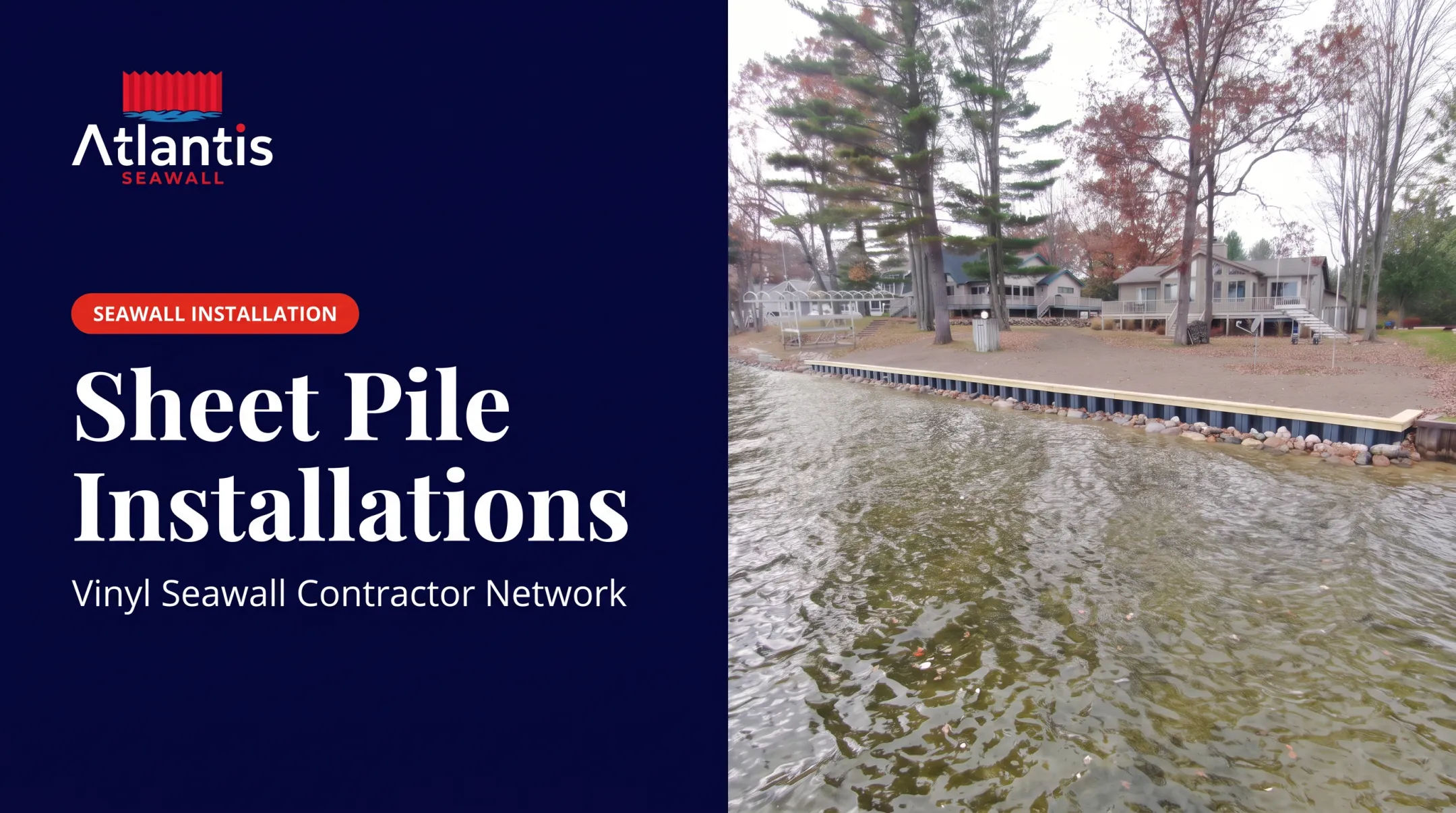
Interlocking vinyl sheet piling suits applications needing a continuous wall: seawalls, bulkheads, retaining walls, pond and canal edges, and erosion control. Federal specification UFGS 31 41 16.16 covers permanent PVC and FRP earth-retaining structures, including bulkheads and cutoff walls.
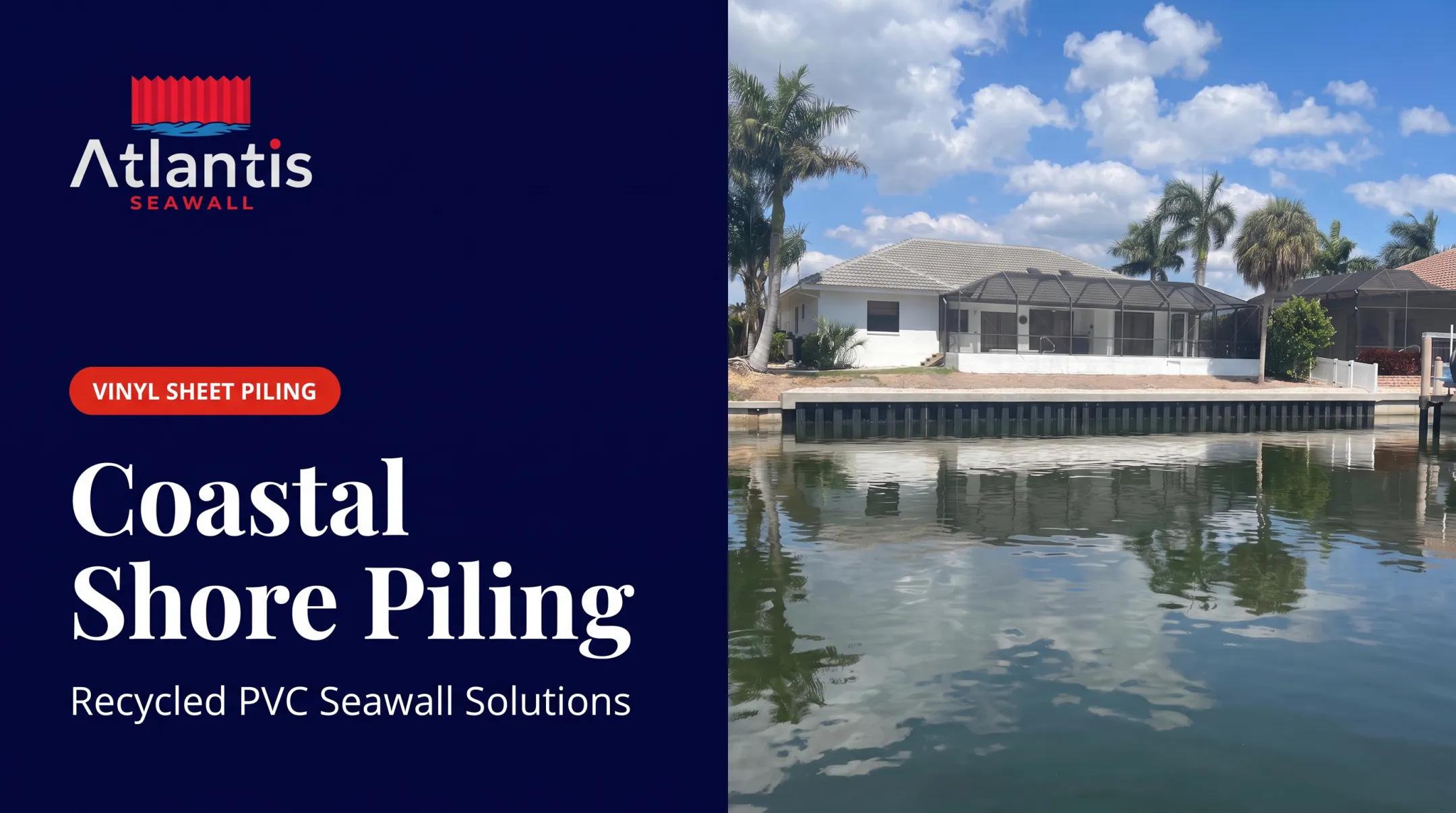
Atlantis Seawall manufactures and supplies recycled PVC vinyl sheet piling from Cleveland, Ohio. It ships products across the United States and coordinates Ohio installation through a network of partner installers. Installation outside Ohio is not part of its service.
Selection considerations include:
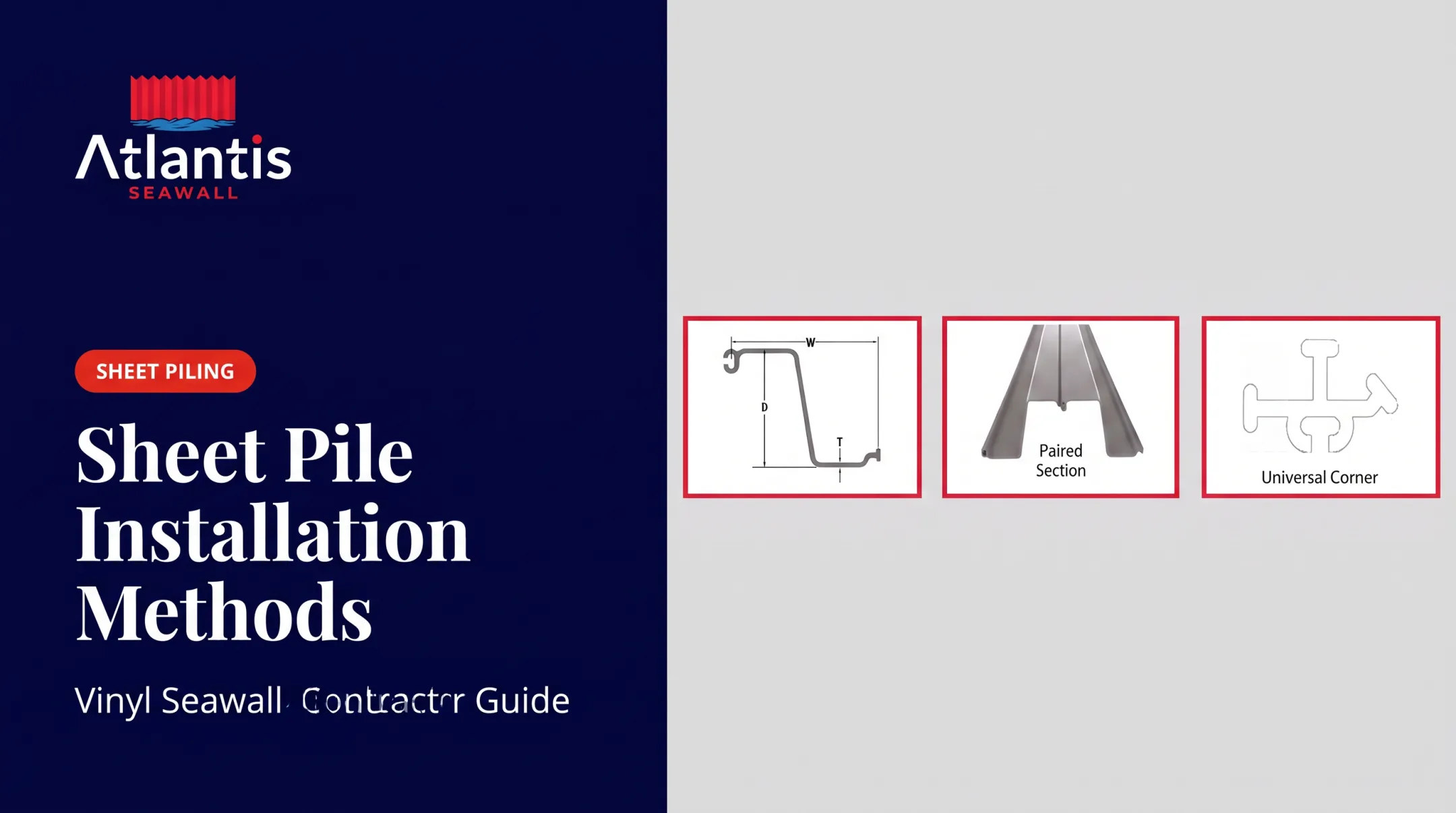
- Lightweight handling (5.5 pounds per foot, 12-inch-wide, 9-inch-deep Z-profile panels)
- Permanent interlock pairing and a universal corner
- Custom lengths in 1-foot increments
- Allowable moments from 5,400 to 11,160 ft-lb/ft across duty grades
- Recycled content and resistance to rot, rust, and corrosion
Depending on soil, 2 to 3 panels can be driven at once with less vibration. Always confirm structural suitability with the project engineer. UFGS notes that hammer sizing depends on pile and subsurface, and that augers or pre-punch tools may serve as aids.
Quality, Safety, Environmental, and Post-Installation Checks
Safety
OSHA 29 CFR 1926.603 covers hammer blocking, keeping workers clear during pile hoisting, and rig stability. Dedicated pile drivers fall under the crane rules in Subpart CC except as specified in 1926.1439. USACE EM 385-1-1 applies when incorporated into the contract.
Plan for:
- Stable working platforms or marine access
- Lifting plans and exclusion zones
- Utility locating
- Qualified operators
- Protection for nearby workers, structures, and the public
Quality Control
Verify these items during and after driving:
- Pile location, plumbness or batter
- Interlock engagement and wall continuity
- Embedment and final elevation
- Visible damage
- Installation records and any specified testing
Permits and Environmental Controls
Pilings in navigable waters require Section 10 authorization under 33 CFR 322.3. Section 404 applies when placement has the effect of a discharge of fill.
Turbidity limits are state-specific. Washington's freshwater criterion is 5 NTU above background when background is 50 NTU or less, but that is not a national threshold. Work windows come from state and project permits.
Also address:
- Noise and vibration
- Groundwater pathways
- Protected species
- Navigation
- Spoil disposal
Post-Installation Checks
After installation, inspect exposed components, drainage, backfill, and bracing. Watch for movement or settlement before closing out the job.
Frequently Asked Questions
What is the process of piling in construction?
Investigate the site, design and lay out the piles, set up equipment, and position each pile. Then drive, press, drill, or jet it, and verify alignment and capacity.
What are the three main types of piles?
It depends on the classification. By installation, they are driven, bored or drilled, and screw or helical piles. End-bearing and friction describe load transfer, and a pile can use both.
Do screw piles need to be filled with concrete?
Not universally. It depends on the hollow or solid design, structural needs, corrosion exposure, manufacturer instructions, and engineer-approved specifications. This does not apply to sheet piles.
What is the difference between impact driving and vibratory pile installation?
Impact driving uses hammer blows; vibratory installation vibrates the pile into the ground. Vibratory works best in granular soils and alone does not establish capacity. Impact driving allows blow-count verification.
How do I choose the right piling installation method?
Weigh soil, pile purpose and material, embedment, access, neighboring structures, environmental limits, and permits. Then confirm the choice with your engineer or contractor.