
Introduction
A pond bank rarely fails all at once. First the edge slumps. Then soil washes out behind the shoreline, a depression opens near the water, and usable yard shrinks a few inches every season.
Owners and contractors then ask whether the fix is a seawall or a retaining wall. The two can look alike, but they answer different questions about water, soil, grade, and nearby property.
This guide compares their functions, design factors, materials, installation needs, and upkeep, so you can scope a pond wall project with fewer surprises.
Key Takeaways
- A seawall or bulkhead protects the water's edge; a retaining wall holds back soil and grade changes.
- No universal embedment depth exists. Engineering sets it from site forces.
- Drainage, anchors, caps, and transitions are structural parts of the wall.
- Vinyl, riprap, vegetation, concrete, steel, wood, and hybrids each fit different sites.
Pond Seawalls vs. Retaining Walls
What a pond seawall does
A seawall, bulkhead, or lakewall sits at or near the waterline. It retains shoreline soil, limits erosion, and defines the edge of the pond or basin. Wisconsin's DNR describes a seawall as a near-vertical structure parallel to shore that retains land and protects the upland.
Forces at work include:
- Fluctuating water levels and rapid drawdown
- Wave action and boat wakes, where boats are present
- Stormwater inflow and seepage
- Scour at the toe of the wall
What a retaining wall does
A retaining wall primarily holds back soil on a slope or grade change. It may sit above the waterline, beside a pond, or behind another shoreline system. Water in the backfill can still be an important load.
Added loads often come from:
- Driveways, roads, and structures
- Fences, landscaping, and heavy equipment
- Stored materials
- Saturated backfill
When the terms overlap
Contractors use "seawall," "bulkhead," "lakewall," and "retaining wall" loosely for inland ponds. Judge a proposal by function and site forces, not its label. One wall can do both jobs when a pond edge also has a grade change.
Warning signs that call for professional evaluation, according to USACE guidance:
- Leaning, tilt, or cracking parallel to the wall
- Bulging, sinkholes, or depressions behind it
- Seepage or soil piping
- Rust, section loss, or rot
- Undercutting and erosion at the base
How to Design a Pond Seawall or Retaining Wall
Evaluate site forces before choosing a wall
Water depth, normal and high-water levels, seasonal swings, wave or flow energy, stormwater discharge, soil type, bank slope, and nearby loads all shape the design. Document them first:
- Topographic survey and elevations
- Water-level observations
- Soil investigation
- Bathymetric or drainage information where appropriate
Height, freeboard, and embedment
Measure visible height from the water and from the retained grade. Freeboard adds crest height for fluctuating water, runoff, waves, or overtopping. Wisconsin's DNR cautions against walls where overtopping keeps eroding the bank behind them.
Embedment is the portion installed below the pond bottom or finished grade. It must resist movement, overturning, rotation, and scour.

There is no safe rule of thumb. USACE calculates penetration depth and anchor force from equilibrium analysis, and moving the anchor changes both. Factors that drive the design include:
- Retained height and soil strength
- Groundwater and water levels
- Wall stiffness and applied loads
- Local code and permit requirements
Have a qualified engineer design complex or heavily loaded walls.
Drainage, filtration, and connections
Water trapped behind a wall builds hydrostatic pressure. Clogged drains raise that pressure and can contribute to sliding or rotation. Plan these together:
- Filter fabric and clean aggregate
- Weep systems or other pressure relief
- Tiebacks, deadmen, anchors, and walers
- Caps, corners, returns, and joints
- Transitions to slopes, docks, paths, or existing structures
USACE flags tie rods, wales, and anchors as common failure locations, so they deserve real attention.
Vertical, sloped, or hybrid protection
Match the protection type to available space and shoreline goals:
- Vertical walls: Best for tight sites and a defined shoreline edge
- Sloped options: Riprap, vegetation, geocells, or articulated concrete when you have room to spread
- Hybrids: A structural wall where space is tight, with softer stabilization elsewhere
Few ponds need one system around the whole perimeter.
Materials and Construction Options
Comparing common materials
| Material | Key considerations |
|---|---|
| Wood | Decay from moisture and fungi reduces strength over time |
| Steel | Corrosion reduces section; needs coating upkeep |
| Concrete | Watch for large cracks and joint movement; seal cracks |
| Vinyl/PVC | Corrosion resistant; design is often controlled by deflection |
| Riprap | Follows the bank and tolerates slight settlement; needs toe and filter design |
| Vegetation | Low-energy sites; plantings may need replacement |
| Hybrid | Rock toe protects plants above from scour |
The best choice depends on water and soil conditions, wall height, service life, environmental constraints, equipment, contractor experience, and your maintenance goals. Vegetation has real upkeep, too: a Washington Ecology case at Lake Spokane needed replacement sedges after one year.
Vinyl sheet piling for ponds and retention basins
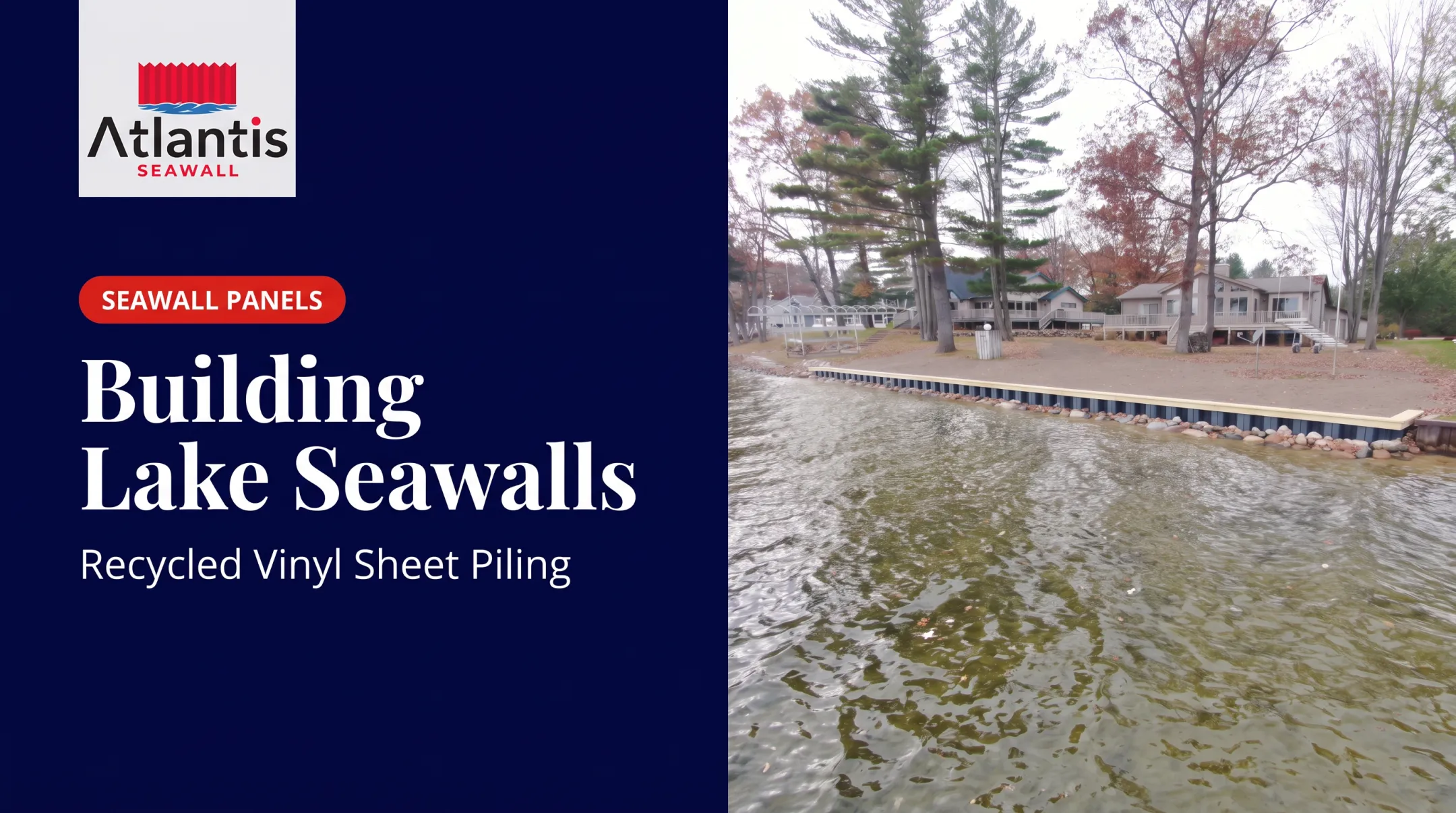
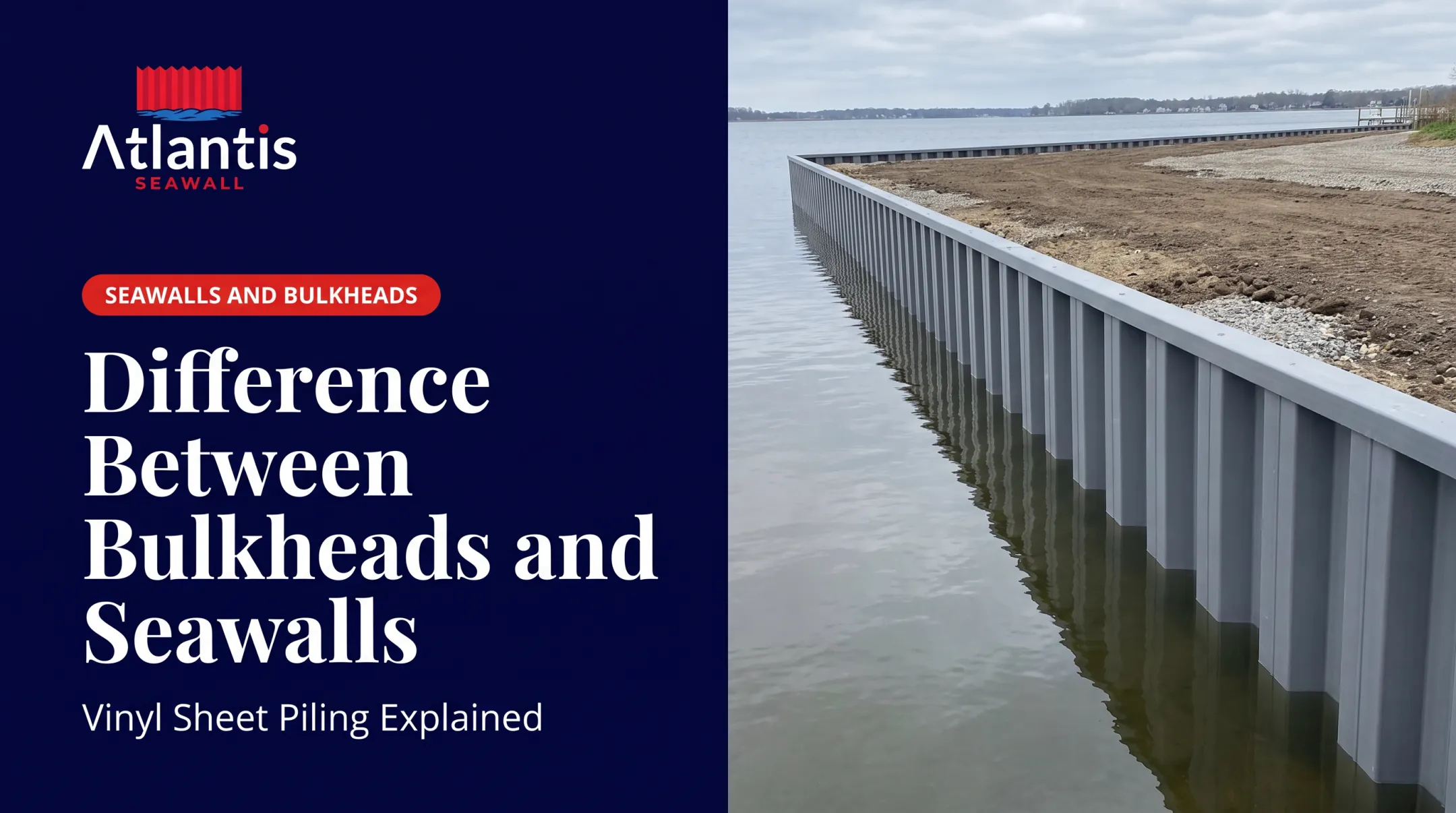
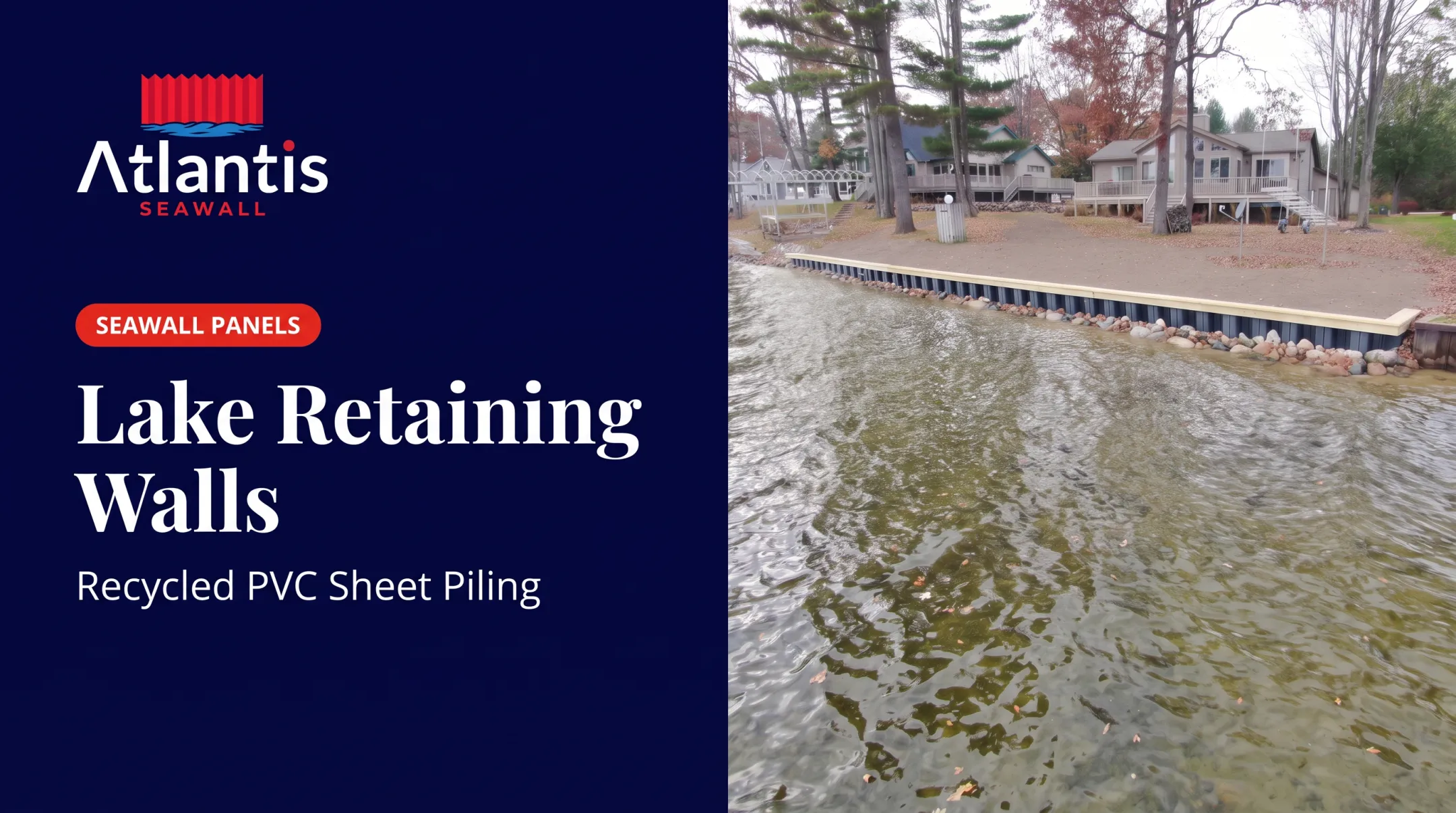
Interlocking vinyl sheet piling forms a continuous barrier. It fits projects that need light handling, corrosion resistance, flexible lengths, and minimal installation disruption.
Atlantis Seawall manufactures its panels in Cleveland, Ohio, from a proprietary 100% recycled PVC blend. Key details:
- 12-inch-wide, 9-inch-deep Z-profile panels
- 300, 400, 450, 500, and 600 duty grades
- Interlock design that permanently pairs sections
- Universal corner profiles, including a 45° corner
- Standard lengths of 8 to 30 feet, with custom 1-foot increments and no charge for custom cuts
- Panel weight of 5.5 pounds per foot
- A 50-year limited transferable warranty; request the written terms
Atlantis reports that two to three panels can be driven at once, depending on soil. Panel allowable moments run from 5,400 ft-lb/ft (300 series) to 11,160 ft-lb/ft (600 series). Match grade to your engineer's loads.

Atlantis ships across the United States, with free shipping on full truckloads of 7,000+ square feet. It supplies contractors, builders, and distributors nationwide, and coordinates installation in Ohio only.
Specify PVC sheet piling to ASTM D8427. ASTM D3679 covers siding, which is a different product.
Matching the system to the project
A vertical wall often wins when:
- Setback is limited
- Infrastructure sits close to the bank
- Significant grade must be retained
- You need to preserve pond width or a defined access point
Alternatives can be more practical for low-energy shorelines with room, natural-appearance goals, drainage channels, or high-flow outlets where a slope dissipates energy better.
Vetting the installer and documentation
Ask contractors about:
- Site investigation and who holds engineering responsibility
- Embedment, drainage, anchors, and backfill
- Cap details and installation equipment
- Environmental controls
- Warranty coverage and maintenance expectations
Before ordering, confirm load assumptions, panel specifications, tolerances, delivery timing, custom-cut availability, and fit with local permit conditions.
Installation, Permits, Drainage, and Maintenance
Preconstruction review and permits
Pond walls may trigger local building or erosion rules, stormwater requirements, wetland or waterway regulations, floodplain limits, HOA approval, and state or federal permits. Not every pond falls under federal jurisdiction, but many do.
Examples:
- Clean Water Act Section 404 covers fill in waters of the U.S., including riprap and seawall fills.
- Nationwide Permit 13 covers bank stabilization with conditions; it is not blanket approval.
- EPA construction stormwater coverage applies at 1 acre or more of disturbance.
- Wisconsin generally requires an individual permit for new seawalls; other states differ.
Contact local, state, and federal authorities before construction. Requirements vary by jurisdiction, waterbody classification, project size, and proximity to wetlands.
Shoreline preparation and access
Prep typically includes:
- Layout and boundary marking
- Utility locating and equipment access
- Temporary water management and sediment controls
- Removal of unstable material
- Protection of nearby landscaping
Soft ground, steep banks, overhead utilities, restricted access, and sensitive areas can change the method, schedule, equipment, and cost.
Typical installation sequence
- Confirm design and alignment.
- Prepare the work area.
- Install or drive wall elements to the engineered elevation.
- Connect corners and transitions.
- Install anchors or reinforcement where specified.
- Place approved drainage and backfill.
- Finish the cap.
The order shifts with water, material, soil, access, dewatering, and whether the job is new, repair, or replacement. Federal specifications also call for undamaged, certified materials and an as-driven survey before concrete goes on top.
Repair or replace
Localized repairs can handle cap damage, a single panel, minor erosion, or drainage deficiencies. Widespread movement, major backfill loss, severe corrosion or rot, undercutting, or inadequate original embedment point toward replacement or redesign.
Get a professional assessment of the root cause. Covering damage without fixing hydrostatic pressure, soil instability, drainage, or scour invites a repeat failure.

Inspection and maintenance
Inspect after major storms and on a regular schedule. Look for:
- Leaning, new cracks, and soil depressions
- Voids and seepage
- Exposed anchors and damaged caps
- Joint separation and toe scour
- Shifts in pond level or shoreline alignment
Maintenance includes:
- Clearing drain outlets and correcting runoff
- Replacing displaced backfill
- Controlling damaging vegetation
- Repairing caps and addressing erosion at transitions
Record changes early.
Contractors, property owners, and project managers planning vinyl sheet piling can talk with Atlantis Seawall about requirements, shipping, custom lengths, or Ohio installation coordinated through partner installers.
Frequently Asked Questions
What are the three types of seawalls?
Classifications vary, but they are commonly vertical or sheet-pile walls, sloped armor such as riprap, and living shorelines using vegetation and natural grades. Site conditions decide which fits.
How deep does a pond seawall need to be?
Depth means engineered embedment. It depends on wall height, soil, water levels, scour, loads, material, and anchoring. Don't use a generic depth without a site-specific design.
Are pond seawalls and retaining walls the same thing?
No. A seawall or bulkhead guards the water's edge, while a retaining wall holds soil. One structure can do both when a pond edge also has a grade change.
What is the best material for a pond seawall?
It depends. Vinyl, steel, wood, concrete, riprap, vegetation, and hybrids suit different soil, exposure, height, access, maintenance, appearance, and engineering needs.
Do I need a permit to build a pond seawall or retaining wall?
Often, yes. Requirements vary with location, waterbody, wetland status, floodplain, stormwater impacts, and scope. Confirm with local, state, and federal authorities.
How can I tell whether a pond wall needs repair or replacement?
Movement, leaning, cracks, exposed backfill, sinkholes, seepage, corrosion, rot, undercutting, and damaged caps are triggers. A professional inspection can identify the underlying cause.