
Get the combination right and the wall controls erosion, creates usable levels, protects structures, and needs few repairs. Get it wrong and it leans, cracks, rots, corrodes, or fails within a few seasons.
This guide covers five options: segmental concrete block, poured reinforced concrete, stone and gabion, pressure-treated timber, and vinyl sheet piling for waterfront and saturated-soil sites. Selection criteria follow.
Key Takeaways
- No single material fits every site; height, soil, water, and loads decide.
- Block, poured concrete, stone or gabion, timber, and vinyl sheet piling each suit different conditions.
- Drainage, base preparation, and backfill drive long-term performance.
- Vinyl sheet piling is a specialized option for waterfront, pond, canal, and retention-basin work.
- Compare lifecycle cost and warranty support, not just upfront price.
Overview of Retaining Wall Materials and Systems in the U.S. Market
A retaining wall laterally supports soil or other fill and keeps it from sliding. The visible facing is only one part. A complete system may include a footing or leveling pad, drainage aggregate, filter fabric, backfill, geogrid or anchors, and engineering.

Common U.S. options include:
- Timber
- Natural stone
- Masonry
- Segmental block
- Poured reinforced concrete
- Gabions
- Sheet piling
Suitability shifts with frost, water, soil type, wall height, and surcharge loads.
Structural type matters too. WSDOT's design manual lists gravity, semigravity, nongravity cantilever, and anchored walls. Sheet piling can act as either cantilevered or anchored, so the categories overlap.
The sections below compare each option on fit, durability, installation, maintenance, drainage, and lifecycle value.
Best Retaining Wall Materials and Systems for U.S. Projects
Each option is judged on:
- Structural suitability and moisture/soil-pressure resistance
- Installation practicality, maintenance, and service life
- Design flexibility, availability, and total value
Cost figures below are local benchmarks, not national averages.
Atlantis Seawall Vinyl Sheet Piling and Waterfront Retaining Systems
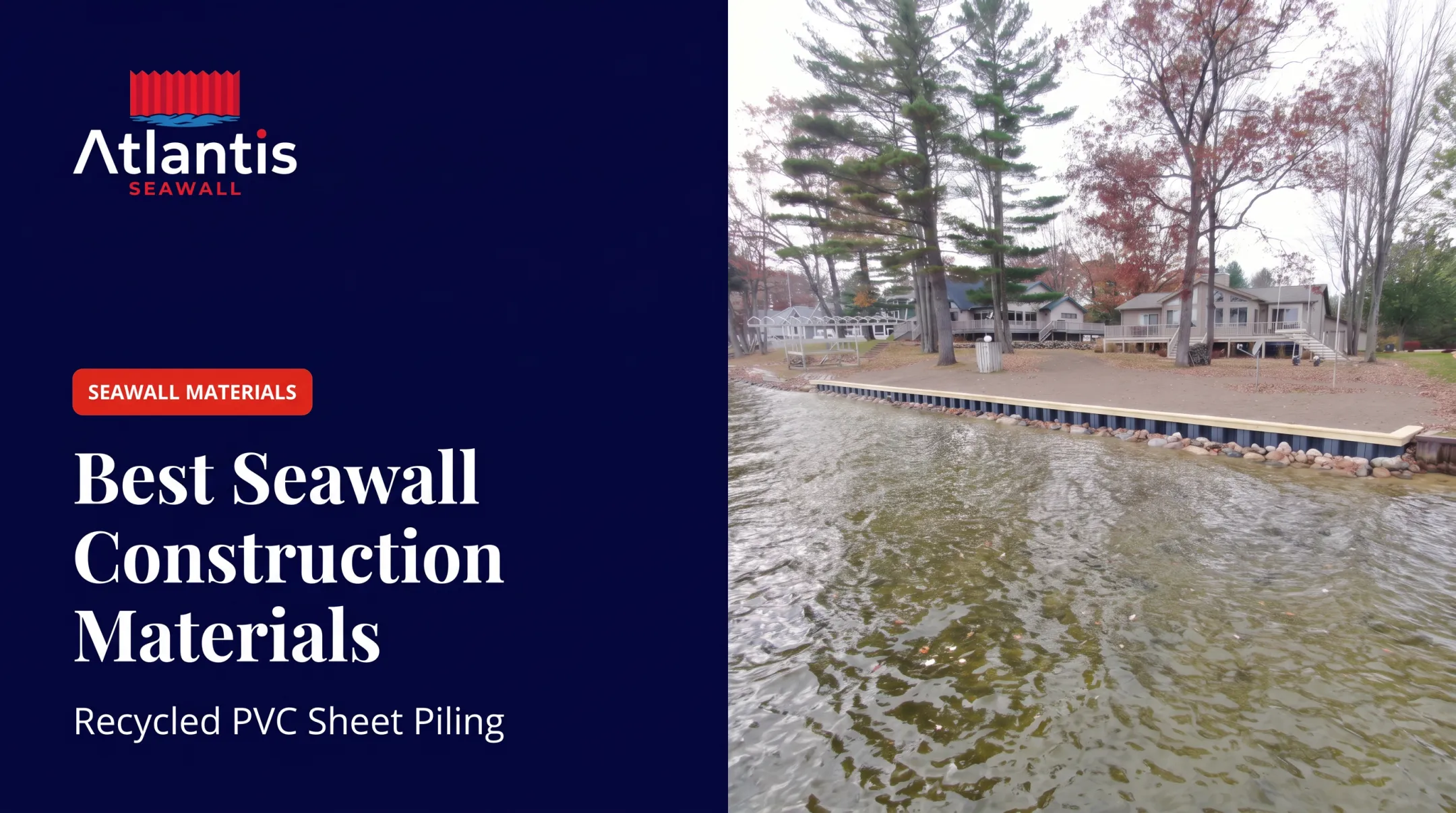
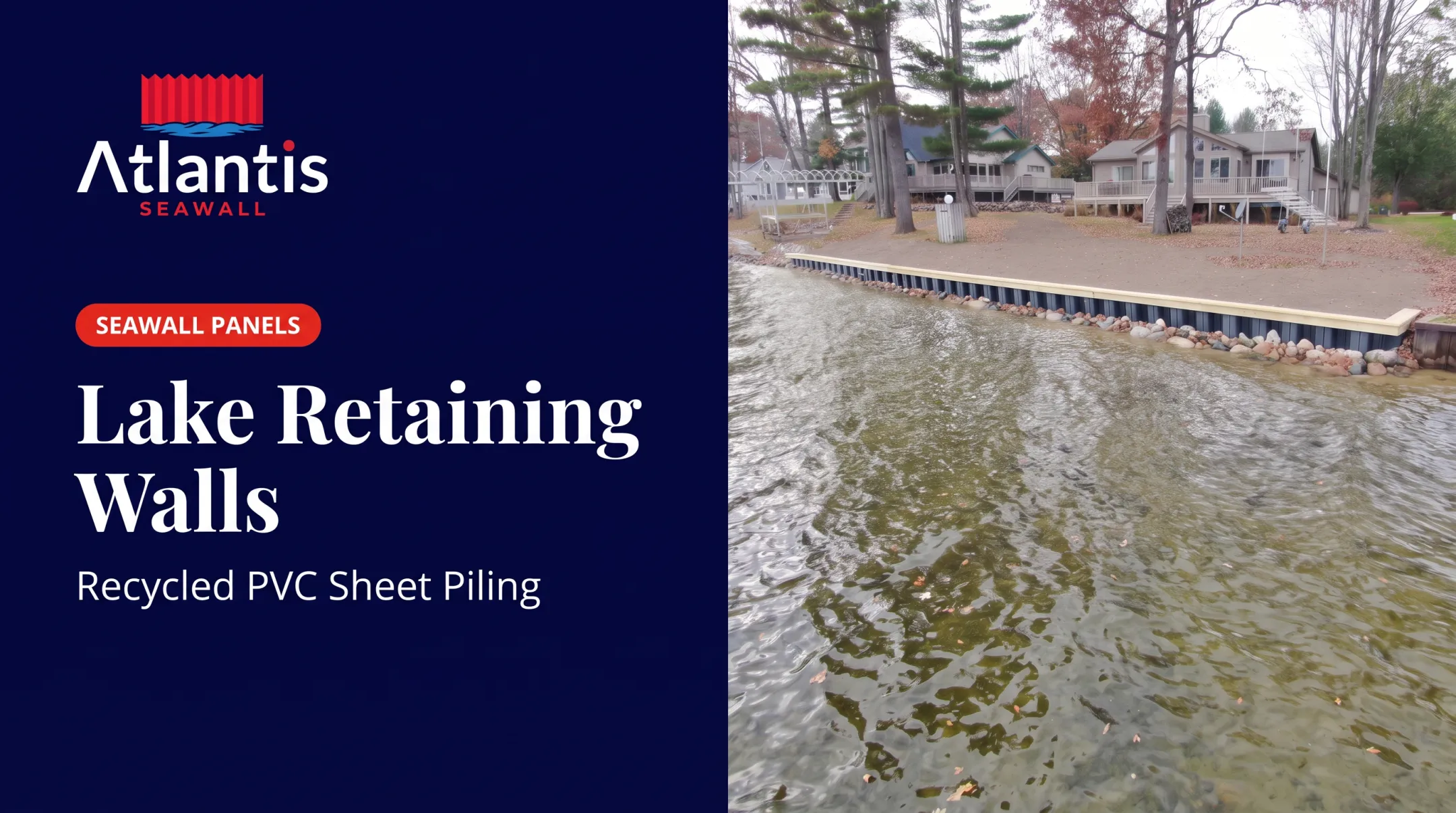
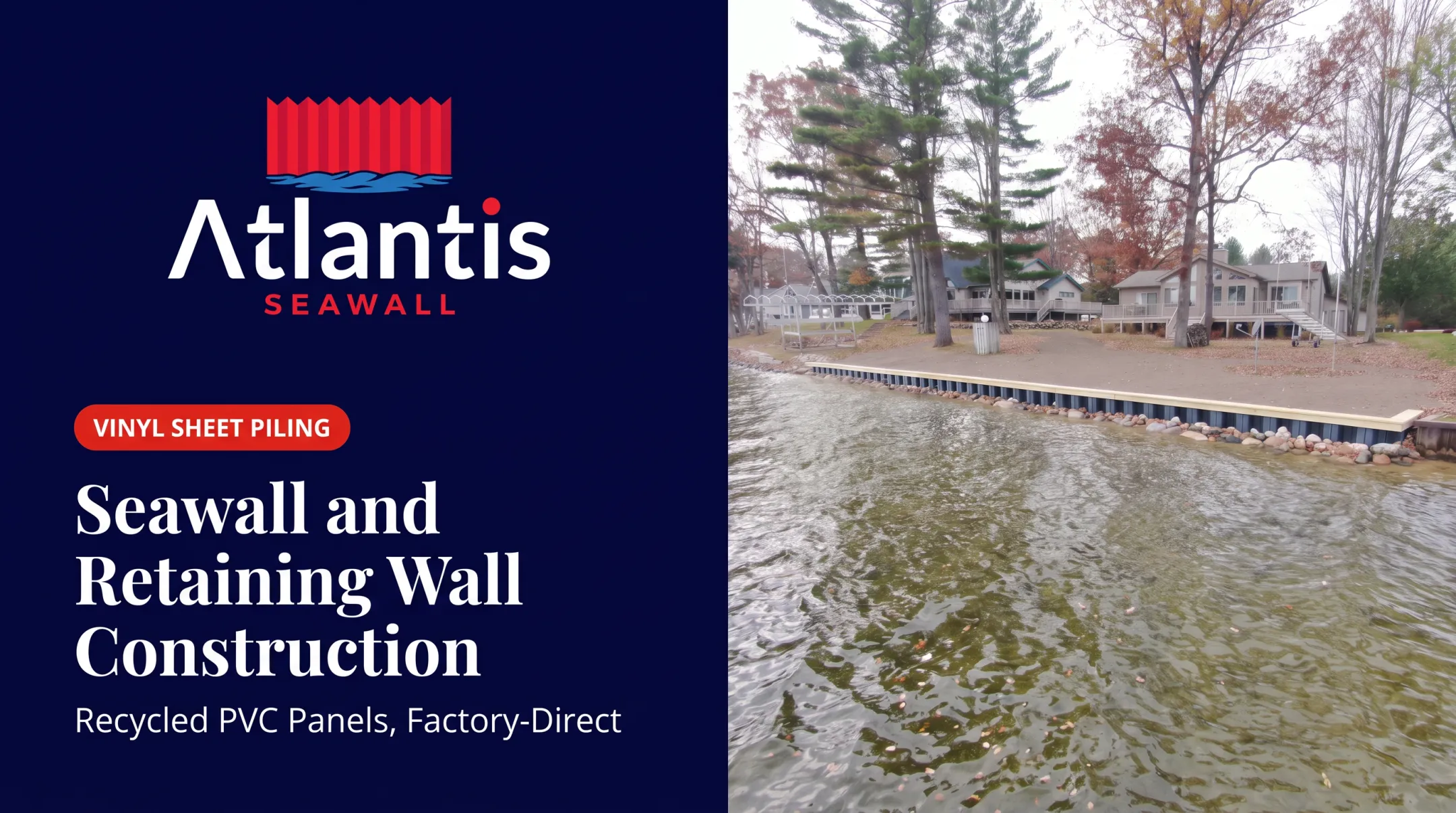
Atlantis Seawall is a Cleveland, Ohio manufacturer of recycled PVC vinyl sheet piling, vinyl seawalls, and vinyl bulkhead materials. The system targets waterfront, pond, canal, retention-basin, and erosion-control work. It is not meant for every dry garden wall.
Product details:
- Proprietary 100% recycled PVC blend
- 12-inch-wide by 9-inch-deep Z-channel profile, 5.5 lb per foot
- Five grades, 300 through 600, with allowable moments of 5,400 to 11,160 ft-lb/ft
- Interlocks that permanently pair panels, plus universal corners
- Standard lengths from 8 to 30 feet; custom lengths in 1-foot increments at no charge
- Nationwide shipping, typically 5-7 days
- 50-year limited transferable warranty
The warranty requires approved engineering design, proper installation, and intended use. Its remedy is a prorated refund or replacement product, excluding labor. Site loads and engineering still decide whether a grade is suitable.
Snapshot
- Cost: About $700-$1,000 per linear foot installed on Long Island, versus $500-$700 for treated wood and $800-$1,200+ for steel or concrete (Pearce Marine, Dec. 2025). Coastal benchmark only.
- Water and corrosion: Federal guidance identifies PVC piling as suitable where corrosion is a concern and exposed height is under 20 ft.
- Anchoring: PVC walls are typically more economical when anchored; deflection often controls design, per federal guidance.
- Handling: Lightweight panels; two to three can be driven at once depending on soil, with minimal vibration.
- Maintenance: Low; no rot or rust.
- Limits: Lower stiffness than steel. Reflected wave energy can still scour a wall's base, so corrosion resistance does not remove that risk.
Segmental Concrete Block Retaining Wall Systems
Interlocking blocks form gravity walls or, with geogrid, reinforced-soil walls. Geogrid extends into the backfill and builds a larger composite mass that resists lateral pressure. Taller walls or heavy loads need that reinforcement.
Strengths:
- Modular installation without heavy equipment on small walls
- Curved and stepped layouts
- Many colors and textures
- Individual units can be replaced
- Widely available
Limits:
- Excavation for the reinforced zone
- Freeze-thaw durability
- Compacted base with a proper drainage zone
Snapshot
- Cost: $20-$35 per sq ft installed, per an undated Indiana contractor guide. Homewyse's 2026 estimate for a dry-fit wall up to 3 ft is higher, at $37.55-$51.76.
- Base: CMHA specifies a minimum 6-inch leveling pad of densely compacted gravel or low-strength concrete, never pea gravel.
- Drainage: At least 12 inches of free-draining aggregate behind the facing and a 4-inch perforated drain.
- Engineering: CMHA recommends a design professional above 4 ft total height, or sooner with surcharges.
- Durability: Blocks should meet ASTM C1372; deicing salts need extra attention.
- Life: No universal lifespan is established, so ask about whole-system warranties rather than block warranties.
Poured Reinforced Concrete and Cantilever Retaining Walls
Poured concrete is a structural system for taller or heavily loaded walls. A cantilever wall uses a reinforced stem on a base footing; counterfort designs take over at greater heights. WisDOT discusses cantilever walls up to 28 ft, though that is transportation guidance, not a residential allowance.
Advantages:
- Strength and continuous construction
- Custom shapes for complex layouts
- Fit for tight sites where mass walls will not work
Drawbacks:
- Cracking and difficult repairs
- Formwork, reinforcement, and heavier equipment
- Plain look unless finished or faced
Snapshot
- Cost: $25-$40 per sq ft
- When it fits: tall walls, heavy surcharges, or constrained sites where a block mass will not fit.
- Footing and steel: designed elements, not a universal thickness or rebar schedule. Engineering is expected.
- Drainage: WisDOT calls for free-draining, non-expansive backfill and weep holes or another positive drainage system.
- Cracking: USACE guidance stresses dense, impermeable concrete with minimal cracking to limit leakage and rebar corrosion.
- Life: USACE uses a 100-year design basis for hydraulic structures, which is not a promise for residential walls.
Natural Stone, Mortared Masonry, and Gabion Retaining Walls
These are related but separate approaches. Dry-stacked stone, mortared masonry, and gabion baskets perform differently, and construction method matters as much as the material.
Where they work: low landscape walls, natural settings, architectural projects, and sites where visual integration counts.
Drawbacks: heavy material, skilled labor, irregular fit, mortar upkeep, basket corrosion risk, and difficult handling.
Snapshot
- Cost: Natural stone runs $30-$50 per sq ft in local market guides. Installed costs for mortared masonry and gabions vary by region and design, so request project-specific quotes.
- Height: Contractors typically place stone under 4 ft. WSDOT lists gabions to 15 ft for routine designs and 21 ft for special designs.
- Foundation: Mortared masonry needs a concrete footing on firm soil, below frost depth where freezing occurs. Gabions need a graded, compacted granular base.
- Drainage: Mortared walls need drainage provisions for water pressure and frost. Gabion voids drain, with geotextile separating soil from the rock.
- Coatings: ASTM A975 covers galvanized and PVC-coated double-twisted gabions. A coating grade does not set a fixed life.
- Life: Stone is often rated for 50+ years; masonry and gabion life depends on design, coatings, and site conditions.
- Limits: Poor fit for high water or heavy-load sites without engineering.
Pressure-Treated Timber Retaining Walls
Timber stays popular for low, budget-minded, or shorter-term walls. It is familiar, light, easy to cut, and warm in appearance.
Limitations: rot, insects, moisture, uneven treatment quality, fastener corrosion, finite life, and poor suitability for tall walls or persistent hydrostatic pressure.
Snapshot
- Cost: $15-$25 per sq ft, often the lowest among common wall materials.
- Height: Contractors typically recommend keeping timber under 3 ft.
- Treatment: AWPA U1 separates UC4A (general ground contact) from UC4B (heavy-duty exposure). Pick the category for the exposure.
- Fasteners: Simpson Strong-Tie recommends stainless steel for ground-contact retentions above UC4A. Hot-dip galvanized is limited to dry service.
- Life: Expect about 15-20 years of service life; ask your supplier for treatment-specific ratings for your exposure.
- Environment: Legacy CCA-treated wood can leach into soil and water, and burning it is not an acceptable disposal option.
- Better elsewhere: Choose another material for tall, wet, or hard-to-replace walls.

How We Chose the Best Retaining Wall Materials and Systems
Start with the wall's job. That use case drives every material and system choice:
- Landscape separation or creating usable grade
- Slope stabilization and foundation protection
- Waterfront erosion control, pond, or canal retention
- Roadway support
Common Mistakes
- Choosing the lowest upfront price
- Treating a seawall like a dry landscape wall
- Ignoring water pressure
- Backfilling with excavated clay
- Assuming a short wall has no structural needs
Performance Factors
Compare each material against the site conditions that actually control performance:
- Wall height and surcharge loads
- Soil type, freeze-thaw, and groundwater
- Wave or runoff action
- Working space and equipment access
Drainage and Base
Water causes more failures than any other factor. A dependable assembly includes:
- A compacted base or leveling pad
- Free-draining aggregate behind the wall
- Filter fabric where soil gradation requires it
- Perforated pipe or weep holes
- A controlled outlet to daylight or a stormwater system
Fabric cannot replace aggregate or an outlet.
Code and Lifecycle Value
Permits and engineering are different triggers. The 2024 IRC exempts walls not over 4 ft from permits, measured from footing bottom to wall top, unless they support a surcharge. Separately, it requires engineered design for walls retaining over 48 inches of unbalanced fill, or over 24 inches with added lateral loads. Local adoption varies, so check your jurisdiction.

Lifecycle cost goes beyond the sticker price. Factor in:
- Labor, excavation, reinforcement, and delivery
- Engineering, permits, and warranty terms
- Maintenance, replacement difficulty, and recycled content
WSDOT includes future maintenance in wall selection, and WisDOT uses a 75-year design life for permanent walls.
Conclusion
The best material matches the site's structural and environmental demands. Looks and lowest price alone do not decide the right system.
Before approving a project, compare:
- Drainage design
- Base and backfill
- Engineering requirements
- Site access
- Maintenance needs
- Lifecycle cost
- Warranty terms
For waterfront, pond, canal, retention-basin, or shoreline work, contact Atlantis Seawall at 216-550-5737 for guidance on vinyl sheet piling, custom lengths, shipping, and installation options through its partner network. Vinyl is not right for every site, so a project assessment comes first.
Frequently Asked Questions
What is the best material for retaining walls?
It depends on wall height, soil, water, loads, appearance, budget, and installation conditions. Block, concrete, stone, and timber suit most landscape walls; vinyl sheet piling is a specialized choice for waterfront sites.
What is the cheapest material to use for a retaining wall?
Timber is lowest in one local guide at $15-$25 per sq ft, ahead of block at $20-$35. Shorter life can erase that saving, so weigh lifetime cost rather than unit price alone.
Do small retaining walls (2-3 ft) need drainage or footings?
Generally yes: use a compacted base and drainage rock. Footings, reinforcement, perforated pipe, and permits depend on material, soil, local code, and loads.
What is the best base material for a retaining wall?
Densely compacted, well-draining crushed gravel, or an engineer-specified base. Poor compaction or trapped water causes settlement and movement.
What is the best material to put behind a retaining wall?
Clean, free-draining aggregate with filter fabric and drainage piping where soil and groundwater call for them. The exact specification depends on wall type and engineering.
What are the four types of retaining walls?
WSDOT lists gravity, semigravity, nongravity cantilever, and anchored walls. Sheet piling is a construction form that can be cantilevered or anchored, so categories overlap.